Skip to header Skip to main navigation Skip to main content Skip to footer

Google's Gemini Agent: One Universal Workplace Agent, Now in Private Preview

Breadcrumb

  • Home
  • Google's Gemini Agent: One Universal Workplace Agent, Now in Private Preview
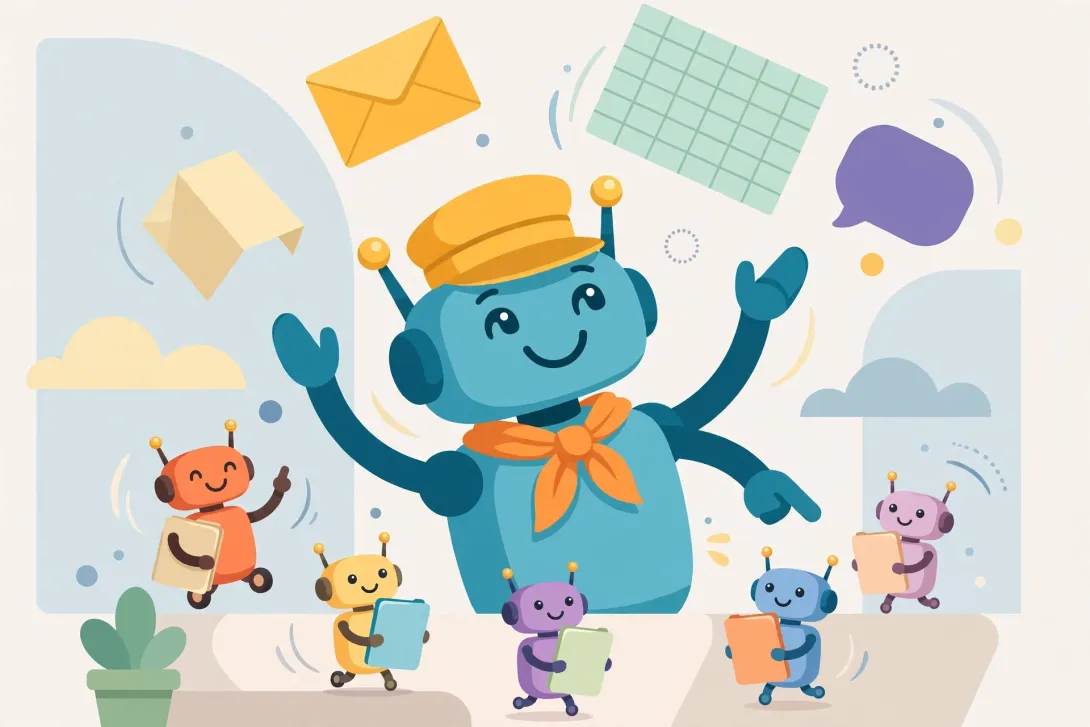
Cartoon illustration of a friendly robot concierge juggling envelopes, documents, spreadsheets, and chat bubbles while directing tiny robot assistants.

Google just made its boldest move in the race to sell AI that does work, not chat: a single universal agent for the workplace, announced at its Gemini at Work 2026 event on October 8.

The pitch, delivered by Google Cloud CEO Thomas Kurian, is simple. Instead of opening a chatbot and pasting in documents, you give the agent an objective. It answers questions, does knowledge work, generates media, writes and runs code, pulls context from business systems, spins up temporary sub-agents for multi-step jobs, and hands back finished work inside Gmail, Docs, Sheets, or the developer environment. It runs in the cloud, holds context across every surface, and keeps working for hours or days after you close your laptop.

The agent reaches inside Google Workspace — Gmail, Drive, Docs, Slides, Sheets, Chat, Calendar — and outside it: Slack, Microsoft 365 including Teams, the command line, and developer tools like Git and Jira. It even creates persistent "coworker agents" — role-based agents that get their own Workspace accounts, email addresses at @agents.company.com, calendars, Drive storage, and a directory entry.

Google is also playing the open card. The agent routes each job to the model that fits best — Smart Routing, they call it — drawing on Gemini models and Anthropic's Claude models today, with OpenAI and open-weights models to follow. Governance features include cryptographically attested agent identities, role-based permissions, audit trails attributed to the agent, an Agent Sandbox with its own network boundary, and per-project spend caps.

The caveat is the calendar. The Gemini agent is in private preview for select customers, with general availability expected by the end of October, starting in North America. Pricing was not disclosed. And nobody has published benchmark numbers for how the agent's coding stacks up against GPT-6, Claude, or specialized coding agents — so any superiority claim is marketing until tested.

This is the interface battle now. Microsoft's redesigned Copilot combines persistent agents, coding, and organizational context; OpenAI is expanding autonomous workflows across connected apps. Google is betting that the winner is not the best model but the best coordinator — the system that carries work between applications and remembers everything.

The Madman take: the agent that owns the memory owns the enterprise.

Rocky Mountain Madman LLC
AI Implementation
Google DeepMind
AI Product News
Enterprise AI
Multimodal AI

Ai Industry News

OpenAI's 722-Paper Math Drop: Millennium Progress or a Verification Crisis?

A cartoon robot mathematician writing abstract shapes on a giant chalkboard in an academic library.

OpenAI has thrown the mathematics world into turmoil. On October 6 and 7, the company published 722 manuscripts on GitHub claiming progress on 372 families of long-standing open problems, spanning theoretical computer science, physics, and mathematics, produced by an unreleased internal AI model whose full capabilities have not been disclosed.

  • Read more about OpenAI's 722-Paper Math Drop: Millennium Progress or a Verification Crisis?

South Korea Bets 3.5 Billion Dollars on a Homegrown Frontier AI Model

A cartoon robot climbing a ladder toward a glowing brain constellation over a stylized Seoul skyline at dusk.

South Korea is going big on AI sovereignty. The Ministry of Science and ICT announced October 6, 2026 that the country will launch a 4.7 trillion won program, roughly 3.5 billion dollars, starting in March 2027 to develop a frontier AI model that can compete with the best in the world.

  • Read more about South Korea Bets 3.5 Billion Dollars on a Homegrown Frontier AI Model

The Genesis Mission Draws 2.4 Billion Dollars in AI Industry Pledges for Federal Science

A cartoon robot holding a glowing atom above a domed government building with satellites orbiting.

Washington's latest bid to wire frontier AI into federal science work now has a price tag: 2.4 billion dollars. A White House fact sheet released October 8, 2026 says eleven industry partners have committed that total in science tools and compute credits to the Genesis Mission Consortium, a push to put modern AI capabilities behind federal research.

  • Read more about The Genesis Mission Draws 2.4 Billion Dollars in AI Industry Pledges for Federal Science

Pagination

  • First page « First
  • Previous page ‹ Previous
  • …
  • Page 5
  • Page 6
  • Page 7
  • Page 8
  • Current page 9
  • Page 10
  • Page 11
  • Page 12
  • Page 13
  • Next page Next ›
  • Last page Last »

Copyright © 2026 Rocky Mountain Madman LLC - All rights reserved

Developed and Designed by Rocky Mountain Madman LLC