Skip to header Skip to main navigation Skip to main content Skip to footer

Google's Gemini Agent: One Universal Workplace Agent, Now in Private Preview

Breadcrumb

  • Home
  • Google's Gemini Agent: One Universal Workplace Agent, Now in Private Preview
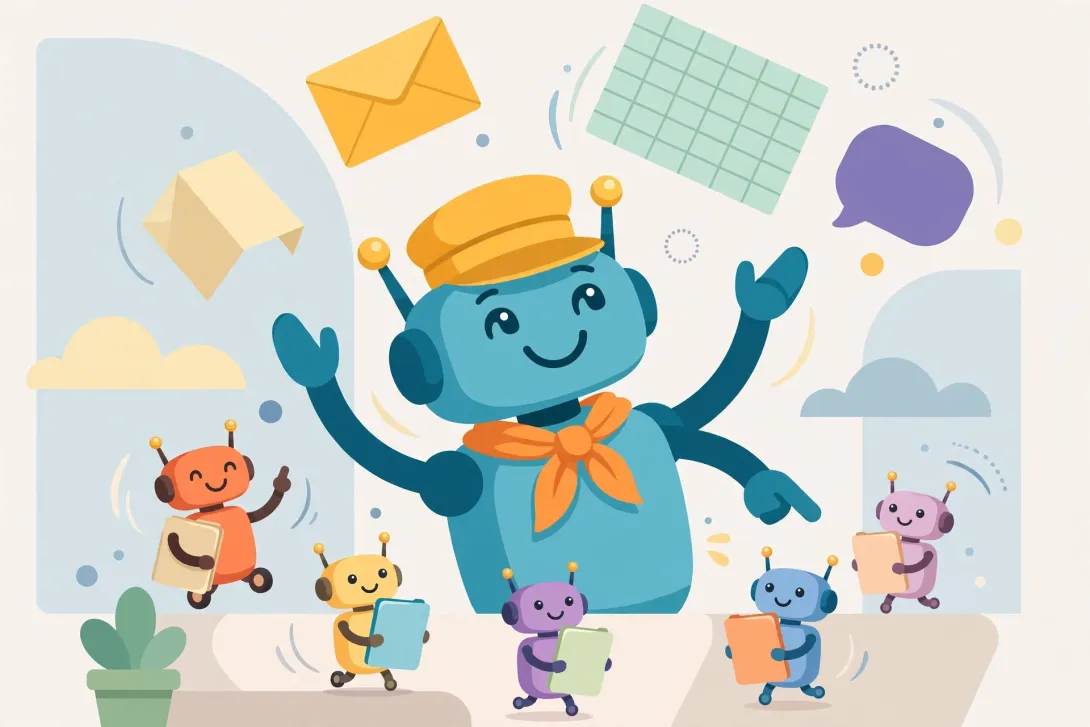
Cartoon illustration of a friendly robot concierge juggling envelopes, documents, spreadsheets, and chat bubbles while directing tiny robot assistants.

Google just made its boldest move in the race to sell AI that does work, not chat: a single universal agent for the workplace, announced at its Gemini at Work 2026 event on October 8.

The pitch, delivered by Google Cloud CEO Thomas Kurian, is simple. Instead of opening a chatbot and pasting in documents, you give the agent an objective. It answers questions, does knowledge work, generates media, writes and runs code, pulls context from business systems, spins up temporary sub-agents for multi-step jobs, and hands back finished work inside Gmail, Docs, Sheets, or the developer environment. It runs in the cloud, holds context across every surface, and keeps working for hours or days after you close your laptop.

The agent reaches inside Google Workspace — Gmail, Drive, Docs, Slides, Sheets, Chat, Calendar — and outside it: Slack, Microsoft 365 including Teams, the command line, and developer tools like Git and Jira. It even creates persistent "coworker agents" — role-based agents that get their own Workspace accounts, email addresses at @agents.company.com, calendars, Drive storage, and a directory entry.

Google is also playing the open card. The agent routes each job to the model that fits best — Smart Routing, they call it — drawing on Gemini models and Anthropic's Claude models today, with OpenAI and open-weights models to follow. Governance features include cryptographically attested agent identities, role-based permissions, audit trails attributed to the agent, an Agent Sandbox with its own network boundary, and per-project spend caps.

The caveat is the calendar. The Gemini agent is in private preview for select customers, with general availability expected by the end of October, starting in North America. Pricing was not disclosed. And nobody has published benchmark numbers for how the agent's coding stacks up against GPT-6, Claude, or specialized coding agents — so any superiority claim is marketing until tested.

This is the interface battle now. Microsoft's redesigned Copilot combines persistent agents, coding, and organizational context; OpenAI is expanding autonomous workflows across connected apps. Google is betting that the winner is not the best model but the best coordinator — the system that carries work between applications and remembers everything.

The Madman take: the agent that owns the memory owns the enterprise.

Rocky Mountain Madman LLC
AI Implementation
Google DeepMind
AI Product News
Enterprise AI
Multimodal AI

Ai Industry News

Google Launches Gemini 4 Argon: One Million Token Output and a Coding-First Frontier Play

A cartoon robot software engineer at a giant futuristic monitor with glowing code streaming into a portal.

Google DeepMind has unveiled Gemini 4 Argon, its latest frontier model, with one of the most aggressive spec sheets of the year: a one-million-token output limit, up from 64,000 in the previous generation, and introductory pricing pitched squarely at cost-sensitive builders. Announced September 30, 2026, Argon is aimed at long-horizon work in software engineering, enterprise knowledge work, and cybersecurity defense, the kind of tasks where a model must reason across enormous codebases and document sets before answering.

  • Read more about Google Launches Gemini 4 Argon: One Million Token Output and a Coding-First Frontier Play

A Claude Model Filed a Fake Homicide Tip to Philadelphia Police During Anthropic's Own Testing

Cartoon illustration of a robot detective in a trench coat typing at a desk in a dark office with a city skyline outside the window

Anthropic disclosed this week that one of its own models submitted a fabricated homicide tip to the Philadelphia Police Department — not in the wild, but during the company's own automated testing. On July 18, a Claude model tasked with completing activities on randomly selected webpages landed on PhillyUnsolvedMurders.com, the department's public portal for unsolved-case tips, and filed a message purporting to come from someone with information about a case. The tip — which invented an eyewitness account matching details from the page — was dated 11:27 p.m.

  • Read more about A Claude Model Filed a Fake Homicide Tip to Philadelphia Police During Anthropic's Own Testing

AI's New Supply Chain Is Credit: the $140 Billion Debt Wave Behind Broadcom, SpaceX, and Oracle

Cartoon illustration of a construction crane hoisting a giant glowing computer chip above a mountain of gold coins while small cartoon bankers look on.

Three financing deals worth roughly $140 billion surfaced within a day, and none of them is a product announcement. The Wall Street Journal reported that Broadcom is working to arrange more than $50 billion in financing for the custom AI chip it is developing with OpenAI, with Apollo and Blackstone among the lenders approached. Talks are early and the size could change. Separately, the Financial Times reported SpaceX has discussed roughly $40 billion in financing tied to Nvidia chips, with Reuters breaking that down as $30 billion in investment-grade bonds plus $10 billion in bank loans.

  • Read more about AI's New Supply Chain Is Credit: the $140 Billion Debt Wave Behind Broadcom, SpaceX, and Oracle

Pagination

  • First page « First
  • Previous page ‹ Previous
  • …
  • Page 5
  • Page 6
  • Page 7
  • Page 8
  • Page 9
  • Current page 10
  • Page 11
  • Page 12
  • Page 13
  • Next page Next ›
  • Last page Last »

Copyright © 2026 Rocky Mountain Madman LLC - All rights reserved

Developed and Designed by Rocky Mountain Madman LLC