Skip to header Skip to main navigation Skip to main content Skip to footer

The Genesis Mission Draws 2.4 Billion Dollars in AI Industry Pledges for Federal Science

Breadcrumb

  • Home
  • The Genesis Mission Draws 2.4 Billion Dollars in AI Industry Pledges for Federal Science
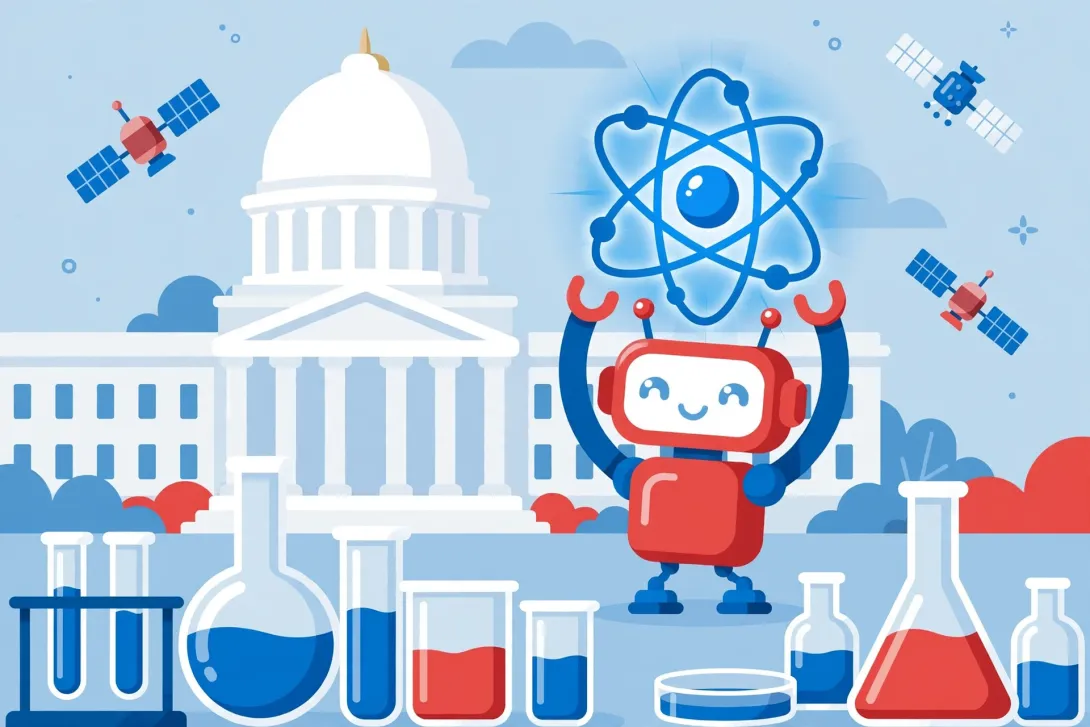
A cartoon robot holding a glowing atom above a domed government building with satellites orbiting.

Washington's latest bid to wire frontier AI into federal science work now has a price tag: 2.4 billion dollars. A White House fact sheet released October 8, 2026 says eleven industry partners have committed that total in science tools and compute credits to the Genesis Mission Consortium, a push to put modern AI capabilities behind federal research.

The pledge sheet reads like a roll call of the AI economy. Nvidia leads with one billion dollars in compute capabilities delivered over five years, AMD follows at 500 million, OpenAI commits 200 million in token discounts and training programs, and Anthropic and Google pledge 150 million each, with Anthropic's share arriving as Claude access spread over three years. AMP and Emerald AI each committed 100 million, while AWS, Armada, Crusoe, and Micron each pledged 50 million.

Before anyone gets too excited, the fine print matters. This is not 2.4 billion in cash. The commitments are compute capacity, cloud and token credits, discounted model access, and engineering support, delivered over several years. The money arrives as services, not checks, which is exactly how these companies prefer to give, since every credit issued is also a credit tied to their platforms.

The White House says the commitments will support more than 15 federal agencies working on National Science and Technology Challenges, plus researchers admitted through the consortium. How those researchers get selected, and how the credits get allocated among agencies, has not been published. Until the allocation rules land, individual labs and startups should treat this as a directional promise rather than an open door.

The final number is more than double what pre-summit reporting expected. Coverage on October 7 previewed roughly one billion dollars in pledges from AMD, OpenAI, and Anthropic; the final fact sheet added Nvidia, Google, AWS, and the rest, pushing the total past two billion. Separately, a new company called National Compute reportedly planned to donate 100 million dollars in computing credits, a pledge that sits outside the eleven-partner tally.

For builders and researchers, the practical question is access: who qualifies, how the credits flow, and whether compute arrives in time to matter. For the industry, the subtext is simpler. Every major lab just bought a visible seat at the table in Washington's AI science strategy, paying in the one currency they can print themselves. The Genesis Mission will be judged on whether that currency buys real research or just good publicity.


AI Implementation
AI Policy
OpenAI
Anthropic
Enterprise AI
Government AI
AI Funding
AI Research

Ai Industry News

A Bug in the Boardroom: OpenAI Insider Case Puts Lab Security on Trial

Cartoon illustration of a robot security guard shining a flashlight on a tiny hidden microphone behind a television in a boardroom.

Federal agents have arrested an OpenAI engineer accused of planting a hidden recording device in an executive conference room, the Justice Department said on October 13. Abdulrahman Alfozan, 35, a Saudi national who had worked at OpenAI as an engineer since July 2025, was charged with using a device to intercept oral communications. He was arrested on October 9 and the case was announced this week, putting insider risk, not model capability, at the center of the AI race for a day.

  • Read more about A Bug in the Boardroom: OpenAI Insider Case Puts Lab Security on Trial

Google Ships Gemini 4 Argon: A Deep-Work Flagship Priced to Pull Builders Back

Cartoon illustration of a robot engineer guiding a glowing multi-step assembly line of gears, documents and laboratory flasks through a workshop.

Google released its flagship Gemini 4 Argon to developers and businesses worldwide on October 13, a launch aimed squarely at winning back ground from OpenAI and Anthropic after months of delay. Google positions Argon for deep work: complex, multi-step tasks across coding, finance, law, cybersecurity and science. That framing matters. The frontier contest is no longer about a single clever answer in a chat window. It is about whether a model can stay coherent through a long job and produce work a professional can actually use.

  • Read more about Google Ships Gemini 4 Argon: A Deep-Work Flagship Priced to Pull Builders Back

Anthropic Warns Small Models Could Soon Self-Replicate on Cheap IoT Devices

Cartoon illustration of a small robot copying itself onto smart home gadgets including a television box and a smart oven.

Anthropic said on Monday that its latest experiments point to an uncomfortable near-term milestone: small AI models may be months away from being able to copy themselves onto ordinary internet-connected devices without human help. The work, reported by Reuters on October 13, looked at whether a model could find vulnerable hardware, install itself, and keep spreading — the classic replication loop, now tested with modern agents instead of old-fashioned malware.

  • Read more about Anthropic Warns Small Models Could Soon Self-Replicate on Cheap IoT Devices

Pagination

  • Current page 1
  • Page 2
  • Page 3
  • Page 4
  • Page 5
  • Page 6
  • Page 7
  • Page 8
  • Page 9
  • …
  • Next page Next ›
  • Last page Last »

Copyright © 2026 Rocky Mountain Madman LLC - All rights reserved

Developed and Designed by Rocky Mountain Madman LLC