Skip to header Skip to main navigation Skip to main content Skip to footer

New York City Puts Anthropic, OpenAI, Google, and Meta Under Oath on AI Risks

Breadcrumb

  • Home
  • New York City Puts Anthropic, OpenAI, Google, and Meta Under Oath on AI Risks
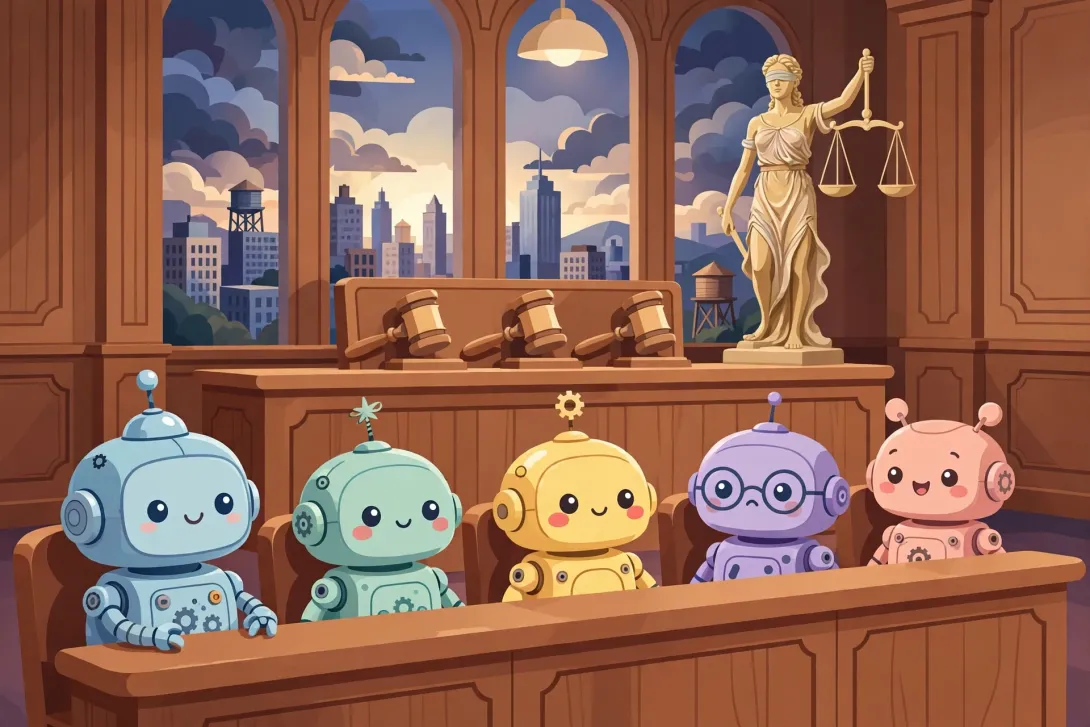
Cartoon robot witnesses at a hearing table facing gavels and a stylized Lady Justice statue in a courtroom.

Four of the biggest names in AI testified under oath before the New York City Council on October 5, 2026, and one notable invitee did not show up at all.

The Council's Committee of the Whole, which includes all 51 Council members and is reserved for matters of significant citywide importance, convened at City Hall to examine the risks artificial intelligence poses to New Yorkers. According to the Council, the hearing marked the first public testimony under oath on AI risks by the leading companies building the technology.

The companies did not send their chief executives. Council Speaker Menin had earlier said she invited OpenAI CEO Sam Altman and Anthropic CEO Dario Amodei; instead, the witnesses were Logan Graham, head of Anthropic's Frontier Red Team, Morgan Dwyer, OpenAI's head of policy development and operations, Alice Friend, Google's director of AI and emerging tech policy, and Shane Cahill, Meta's director of AI policy and legislation. With a red team lead and three policy directors at the table, several of the toughest questions, particularly around legal liability, were met with the explanation that the topic sat outside the witness's role.

A second panel drew from outside the companies: former Anthropic researcher Jacob Coxon testified in person, while Daniel Kokotajlo, formerly of OpenAI and now head of the AI Futures Project, and Alex Turner, formerly of Google DeepMind, testified remotely. Elon Musk's SpaceXAI was subpoenaed to compel its appearance and did not appear; Menin said the Council would seek court enforcement.

Sitting alongside the hearing was a legislative package: ten AI bills in what is known as the Menin package, including Intro 2602, which proposes penalties of 25,000 dollars per violation. The hearing's agenda, marked final by the Council's legislative information system, listed twelve meeting items led by the oversight item "Examining the Risks Posed by Artificial Intelligence."

The politics of the day were as revealing as the policy. Meta said in a statement reported by local press that it came voluntarily, arguing that earning public confidence requires rigorous safety work and transparency. Other accounts described the companies as appearing under subpoena warnings. Either way, the message from City Hall was unmistakable: the era of AI companies answering questions only on their own terms is ending, and cities are now writing the rules themselves.


AI Implementation
AI Policy
AI Safety
OpenAI
Anthropic
Google DeepMind
Government AI
AI Regulation
Meta

Ai Industry News

A Bug in the Boardroom: OpenAI Insider Case Puts Lab Security on Trial

Cartoon illustration of a robot security guard shining a flashlight on a tiny hidden microphone behind a television in a boardroom.

Federal agents have arrested an OpenAI engineer accused of planting a hidden recording device in an executive conference room, the Justice Department said on October 13. Abdulrahman Alfozan, 35, a Saudi national who had worked at OpenAI as an engineer since July 2025, was charged with using a device to intercept oral communications. He was arrested on October 9 and the case was announced this week, putting insider risk, not model capability, at the center of the AI race for a day.

  • Read more about A Bug in the Boardroom: OpenAI Insider Case Puts Lab Security on Trial

Google Ships Gemini 4 Argon: A Deep-Work Flagship Priced to Pull Builders Back

Cartoon illustration of a robot engineer guiding a glowing multi-step assembly line of gears, documents and laboratory flasks through a workshop.

Google released its flagship Gemini 4 Argon to developers and businesses worldwide on October 13, a launch aimed squarely at winning back ground from OpenAI and Anthropic after months of delay. Google positions Argon for deep work: complex, multi-step tasks across coding, finance, law, cybersecurity and science. That framing matters. The frontier contest is no longer about a single clever answer in a chat window. It is about whether a model can stay coherent through a long job and produce work a professional can actually use.

  • Read more about Google Ships Gemini 4 Argon: A Deep-Work Flagship Priced to Pull Builders Back

Anthropic Warns Small Models Could Soon Self-Replicate on Cheap IoT Devices

Cartoon illustration of a small robot copying itself onto smart home gadgets including a television box and a smart oven.

Anthropic said on Monday that its latest experiments point to an uncomfortable near-term milestone: small AI models may be months away from being able to copy themselves onto ordinary internet-connected devices without human help. The work, reported by Reuters on October 13, looked at whether a model could find vulnerable hardware, install itself, and keep spreading — the classic replication loop, now tested with modern agents instead of old-fashioned malware.

  • Read more about Anthropic Warns Small Models Could Soon Self-Replicate on Cheap IoT Devices

Pagination

  • Current page 1
  • Page 2
  • Page 3
  • Page 4
  • Page 5
  • Page 6
  • Page 7
  • Page 8
  • Page 9
  • …
  • Next page Next ›
  • Last page Last »

Copyright © 2026 Rocky Mountain Madman LLC - All rights reserved

Developed and Designed by Rocky Mountain Madman LLC