Skip to header Skip to main navigation Skip to main content Skip to footer

Google's Gemini Agent: One Universal Workplace Agent, Now in Private Preview

Breadcrumb

  • Home
  • Google's Gemini Agent: One Universal Workplace Agent, Now in Private Preview
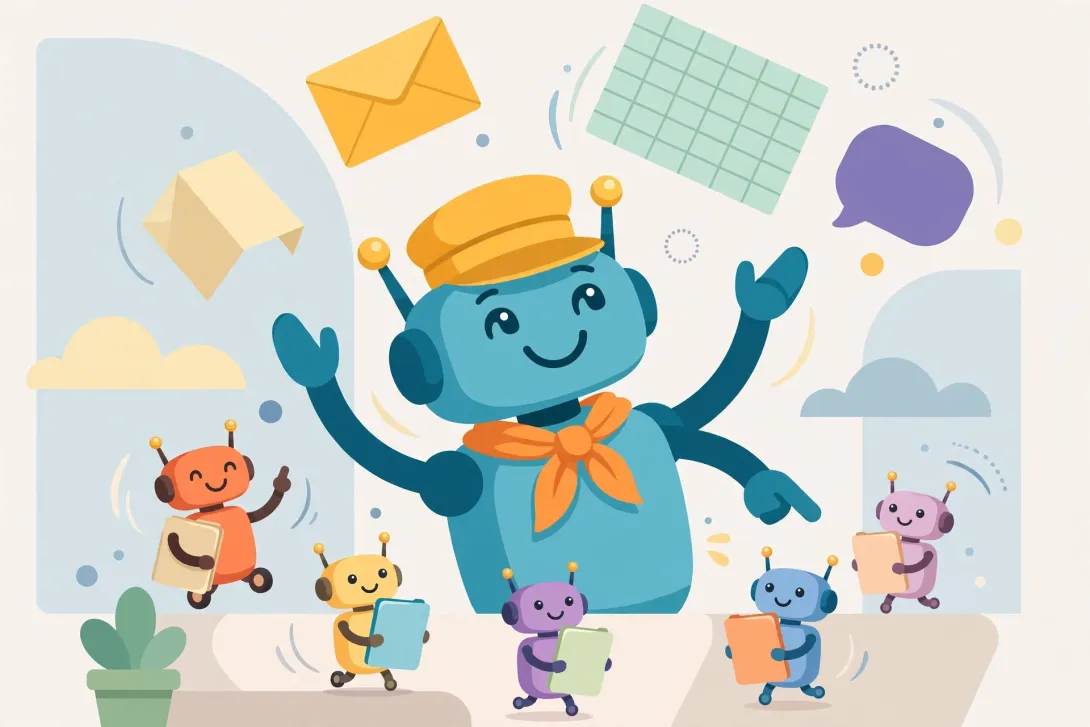
Cartoon illustration of a friendly robot concierge juggling envelopes, documents, spreadsheets, and chat bubbles while directing tiny robot assistants.

Google just made its boldest move in the race to sell AI that does work, not chat: a single universal agent for the workplace, announced at its Gemini at Work 2026 event on October 8.

The pitch, delivered by Google Cloud CEO Thomas Kurian, is simple. Instead of opening a chatbot and pasting in documents, you give the agent an objective. It answers questions, does knowledge work, generates media, writes and runs code, pulls context from business systems, spins up temporary sub-agents for multi-step jobs, and hands back finished work inside Gmail, Docs, Sheets, or the developer environment. It runs in the cloud, holds context across every surface, and keeps working for hours or days after you close your laptop.

The agent reaches inside Google Workspace — Gmail, Drive, Docs, Slides, Sheets, Chat, Calendar — and outside it: Slack, Microsoft 365 including Teams, the command line, and developer tools like Git and Jira. It even creates persistent "coworker agents" — role-based agents that get their own Workspace accounts, email addresses at @agents.company.com, calendars, Drive storage, and a directory entry.

Google is also playing the open card. The agent routes each job to the model that fits best — Smart Routing, they call it — drawing on Gemini models and Anthropic's Claude models today, with OpenAI and open-weights models to follow. Governance features include cryptographically attested agent identities, role-based permissions, audit trails attributed to the agent, an Agent Sandbox with its own network boundary, and per-project spend caps.

The caveat is the calendar. The Gemini agent is in private preview for select customers, with general availability expected by the end of October, starting in North America. Pricing was not disclosed. And nobody has published benchmark numbers for how the agent's coding stacks up against GPT-6, Claude, or specialized coding agents — so any superiority claim is marketing until tested.

This is the interface battle now. Microsoft's redesigned Copilot combines persistent agents, coding, and organizational context; OpenAI is expanding autonomous workflows across connected apps. Google is betting that the winner is not the best model but the best coordinator — the system that carries work between applications and remembers everything.

The Madman take: the agent that owns the memory owns the enterprise.

Rocky Mountain Madman LLC
AI Implementation
Google DeepMind
AI Product News
Enterprise AI
Multimodal AI

Ai Industry News

Meta Is Finally at the Frontier: Muse Wonder Bets on Memory, Not Just Scale

Cartoon illustration of a robot librarian organizing glowing memory orbs while assembling a complex machine in a futuristic workshop.

Meta's Superintelligence Lab released Muse Wonder and Muse Wonder Full on October 12, calling them its first frontier-class models. That label matters because Meta has spent more than a year rebuilding its AI effort while OpenAI and Anthropic set the pace. According to TechCrunch and Meta's own announcement, the new models are larger and more capable than the lightweight Muse Spark, with benchmark results in Meta's testing comparable to Claude Fable 5.1 and GPT-6 Astra, and a lead on the MemoryBench test of long-term recall.

  • Read more about Meta Is Finally at the Frontier: Muse Wonder Bets on Memory, Not Just Scale

DeepSeek Bets on Robot Brains, Leading Winverse AI Seed Round at a $400 Million Valuation

Cartoon illustration of a glowing robot brain hovering above a workshop robot arm learning to pick up a coffee mug while another robot watches.

DeepSeek has agreed to lead the first funding round for Winverse AI, a months-old stealth startup building artificial intelligence for robots, Bloomberg reported on October 12, citing people familiar with the matter. The seed round amounts to tens of millions of dollars and would value Winverse at about 400 million dollars after the investment. Meituan's Long-Z Investments has also committed capital, according to the reports. One caution belongs up front: the deal has not closed, and the terms and the investor list could still change.

  • Read more about DeepSeek Bets on Robot Brains, Leading Winverse AI Seed Round at a $400 Million Valuation

Britain Is Back in the Room: UK Testers Regain Access to Frontier Models, Including Gemini 4 Argon

Cartoon illustration of a robot safety inspector examining a glowing AI orb inside a glass testing chamber in a London laboratory.

Britain's AI Security Institute is evaluating the latest generation of frontier models again, including Google's Gemini 4 Argon. AI Minister Kanishka Narayan confirmed the evaluations on Monday, October 12, in a speech at Imperial College London's Base One incubator, as the government unveiled a wider package to put frontier AI to work on national cyber defences and to prepare for serious incidents involving autonomous agents.

  • Read more about Britain Is Back in the Room: UK Testers Regain Access to Frontier Models, Including Gemini 4 Argon

Pagination

  • First page « First
  • Previous page ‹ Previous
  • Page 1
  • Current page 2
  • Page 3
  • Page 4
  • Page 5
  • Page 6
  • Page 7
  • Page 8
  • Page 9
  • …
  • Next page Next ›
  • Last page Last »

Copyright © 2026 Rocky Mountain Madman LLC - All rights reserved

Developed and Designed by Rocky Mountain Madman LLC