Skip to header Skip to main navigation Skip to main content Skip to footer

Trump Signs Executive Order 14434: Federal Agencies Must Say 'Super Intelligence'

Breadcrumb

  • Home
  • Trump Signs Executive Order 14434: Federal Agencies Must Say 'Super Intelligence'
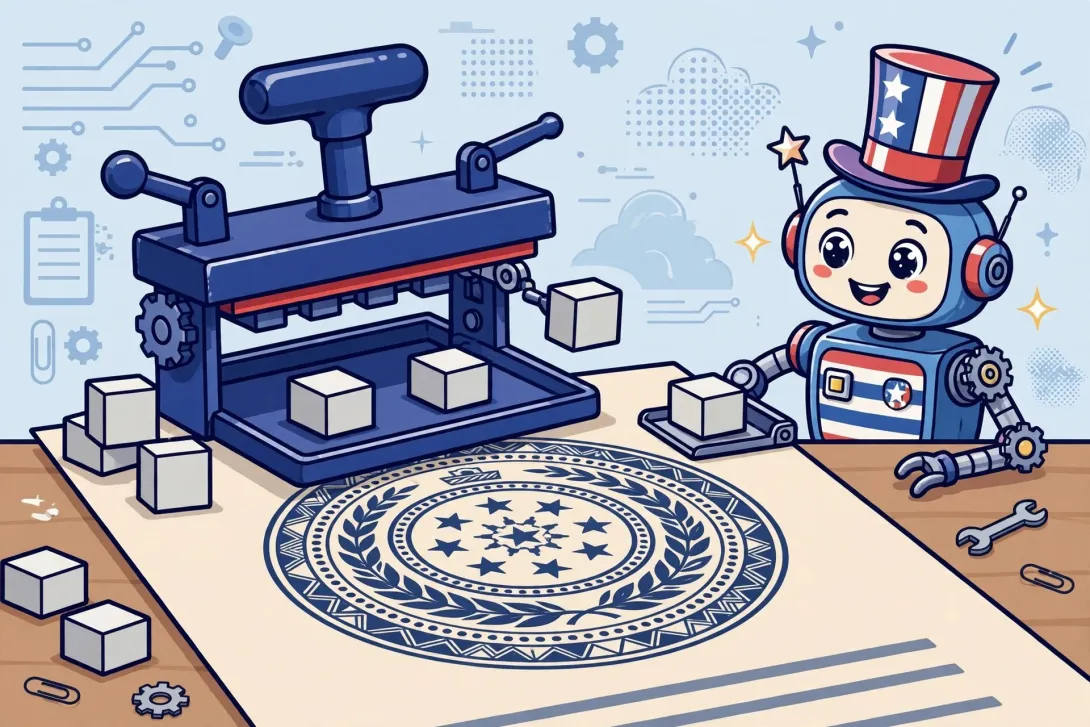
Cartoon illustration of a giant government rubber stamp swapping letter blocks on an official seal while a patriotic cartoon robot looks on.

The federal government no longer says "artificial intelligence." It says "Super Intelligence" — capital S, capital I — and President Trump would like you to know he is serious about the rebrand.

On September 29, Trump signed Executive Order 14434, "Inaugurating the Era of Super Intelligence," directing federal agencies to use "Super Intelligence" and "SI" instead of "artificial intelligence" and "AI" in official correspondence, websites, reports, policy documents, and other non-statutory documents — to the maximum extent permitted by law. The order was published in the Federal Register on October 2.

The seeds were planted a week earlier. On September 22, speaking at the UN General Assembly, Trump said he would rename the technology because "artificial" makes it sound fake. A State Department bureau started swapping the term in staff remarks days later.

Here is what actually changed: nothing technical. The order defines "Super Intelligence" as covering exactly the technologies already captured by the statutory definition of artificial intelligence in 15 U.S.C. 9401(3). Existing laws, contracts, and grants are untouched. There are no penalties. Private companies are not required to rename anything — though Elon Musk voluntarily renamed SpaceXAI to SpaceXSI on October 4, because of course he did.

The machinery is moving anyway. Acting Deputy Attorney General Trent McCotter issued a memo on October 6 requiring the terminology across DOJ communications, including court filings where appropriate. AI.gov began rebranding on October 8 — its logo now reads "SI GOV" — though the transition is a mess: the domain is still ai.gov and half the site's metadata still says AI.

Trump escalated the theater on October 8, posting on Truth Social that people who use "artificial intelligence" instead of "Super Intelligence" are "THE ENEMY!" The public, meanwhile, is unmoved: a YouGov poll found 53 percent prefer "artificial intelligence" and just 9 percent prefer "super intelligence." California's governor reportedly told state agencies to keep saying AI.

The order's one substantive provision is a 60-day task: the White House science and technology adviser must propose legislative language for a federal definition of Super Intelligence by late November. That definition could eventually diverge from international standards and existing statutes — the part of this story that might actually matter.

The same day the order was signed, CEOs from Google, Meta, Anthropic, OpenAI, Nvidia, and xAI signed a voluntary White House Accord on Super Intelligence — internal controls, independent assessments, board-level oversight, no enforcement. A pledge, in other words.

Call it what you want. The technology did not change. Only the letterhead did.

Rocky Mountain Madman LLC
AI Implementation
Government AI
AI Policy
AI Regulation

Ai Industry News

GPT-6 Goes Wide: OpenAI's Full Rollout and the End of the Plain Chatbox

Cartoon illustration of a glowing chat bubble transforming into floating interactive cards, checklists, and charts in a playful flat style.

OpenAI's "28 Days of Continuous Releases" stunt hit Day 3 with its biggest consumer move yet: the GPT-6 model series is now rolling out globally to every ChatGPT user, free and paid. Plus and Team subscribers get GPT-6 Sol, while free and Go users will see GPT-5.6 gradually replaced by GPT-6 Luna. Alongside the rollout, OpenAI says Codex and Work weekly active users have passed 40 million, with usage quotas reset across the board.

  • Read more about GPT-6 Goes Wide: OpenAI's Full Rollout and the End of the Plain Chatbox

Mistral Goes Big: Large 4 "Le Chonk" Puts Europe on the Frontier Map

Cartoon illustration of a colossal friendly robot shaped like a mountain peak with glowing circuit patterns, towering over a stylized European cityscape at dusk.

Mistral has finally shipped a frontier-class model, and it is a statement piece. Large 4, immediately nicknamed "Le Chonk" by an internet that could not resist, is a natively multimodal mixture-of-experts model with 1.05 trillion total parameters and 49 billion active parameters, wrapped around a 1-million-token context window. It was trained from scratch on 3,800 Grace Blackwell GPUs in Mistral's own European datacenters — no rented American cloud, no borrowed infrastructure — and it is available right now as a public preview through Mistral's API.

  • Read more about Mistral Goes Big: Large 4 "Le Chonk" Puts Europe on the Frontier Map

Anthropic Slashes Haiku Pricing 90% as the Small-Model Price War Hits the Enterprise

Cartoon illustration of a cheerful robot mechanic tuning a row of small friendly robots at a workbench, with blank price tags floating in the air.

Anthropic released Claude Haiku 5.5 on October 7 with a price cut that rearranges the math of production AI work: about 90 percent cheaper than Haiku 4.5 on the prompts that matter. Short-context requests up to 100,000 tokens now cost 10 cents per million input tokens and 50 cents per million output tokens, with cache reads at a penny. Above the 100k line the discount drops to 50 percent.

  • Read more about Anthropic Slashes Haiku Pricing 90% as the Small-Model Price War Hits the Enterprise

Pagination

  • First page « First
  • Previous page ‹ Previous
  • …
  • Page 5
  • Page 6
  • Page 7
  • Page 8
  • Page 9
  • Page 10
  • Page 11
  • Current page 12
  • Page 13
  • Next page Next ›
  • Last page Last »

Copyright © 2026 Rocky Mountain Madman LLC - All rights reserved

Developed and Designed by Rocky Mountain Madman LLC