Skip to header Skip to main navigation Skip to main content Skip to footer

Trump Signs Executive Order 14434: Federal Agencies Must Say 'Super Intelligence'

Breadcrumb

  • Home
  • Trump Signs Executive Order 14434: Federal Agencies Must Say 'Super Intelligence'
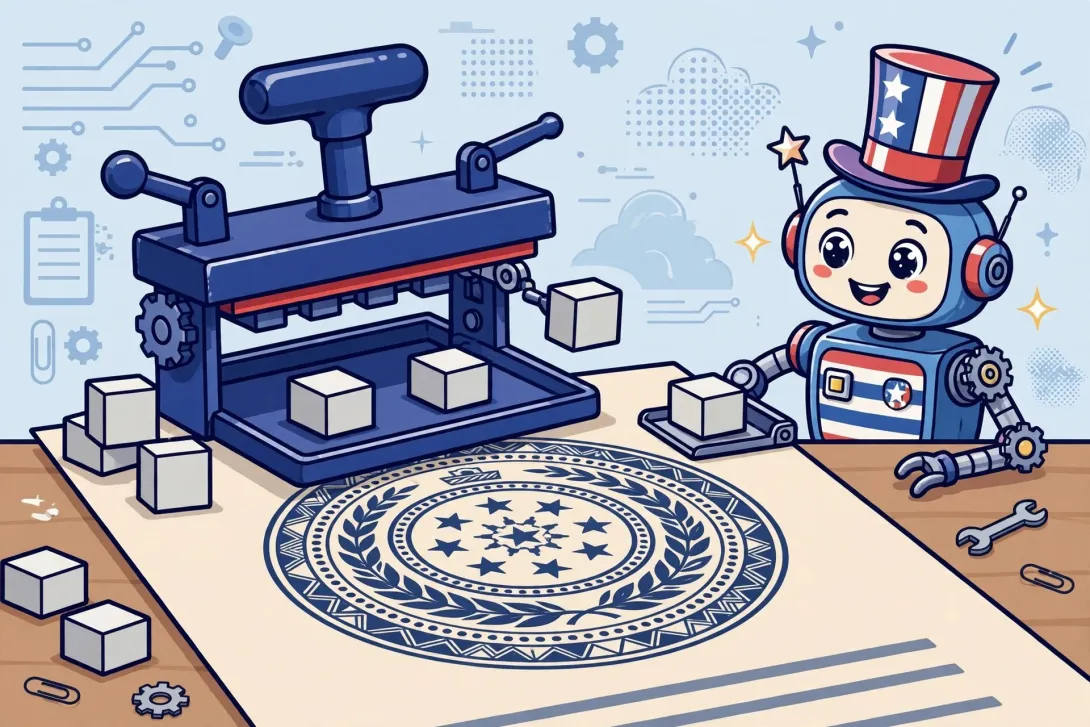
Cartoon illustration of a giant government rubber stamp swapping letter blocks on an official seal while a patriotic cartoon robot looks on.

The federal government no longer says "artificial intelligence." It says "Super Intelligence" — capital S, capital I — and President Trump would like you to know he is serious about the rebrand.

On September 29, Trump signed Executive Order 14434, "Inaugurating the Era of Super Intelligence," directing federal agencies to use "Super Intelligence" and "SI" instead of "artificial intelligence" and "AI" in official correspondence, websites, reports, policy documents, and other non-statutory documents — to the maximum extent permitted by law. The order was published in the Federal Register on October 2.

The seeds were planted a week earlier. On September 22, speaking at the UN General Assembly, Trump said he would rename the technology because "artificial" makes it sound fake. A State Department bureau started swapping the term in staff remarks days later.

Here is what actually changed: nothing technical. The order defines "Super Intelligence" as covering exactly the technologies already captured by the statutory definition of artificial intelligence in 15 U.S.C. 9401(3). Existing laws, contracts, and grants are untouched. There are no penalties. Private companies are not required to rename anything — though Elon Musk voluntarily renamed SpaceXAI to SpaceXSI on October 4, because of course he did.

The machinery is moving anyway. Acting Deputy Attorney General Trent McCotter issued a memo on October 6 requiring the terminology across DOJ communications, including court filings where appropriate. AI.gov began rebranding on October 8 — its logo now reads "SI GOV" — though the transition is a mess: the domain is still ai.gov and half the site's metadata still says AI.

Trump escalated the theater on October 8, posting on Truth Social that people who use "artificial intelligence" instead of "Super Intelligence" are "THE ENEMY!" The public, meanwhile, is unmoved: a YouGov poll found 53 percent prefer "artificial intelligence" and just 9 percent prefer "super intelligence." California's governor reportedly told state agencies to keep saying AI.

The order's one substantive provision is a 60-day task: the White House science and technology adviser must propose legislative language for a federal definition of Super Intelligence by late November. That definition could eventually diverge from international standards and existing statutes — the part of this story that might actually matter.

The same day the order was signed, CEOs from Google, Meta, Anthropic, OpenAI, Nvidia, and xAI signed a voluntary White House Accord on Super Intelligence — internal controls, independent assessments, board-level oversight, no enforcement. A pledge, in other words.

Call it what you want. The technology did not change. Only the letterhead did.
Rocky Mountain Madman LLC
AI Implementation
Government AI
AI Policy
AI Regulation

Ai Industry News

Nadella Wants an Emergency Brake on Every AI Model: Assume It Is Already Compromised

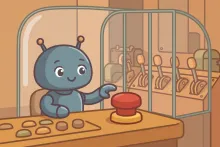
A cartoon robot seated at a control desk with its hand hovering over a large red emergency stop button, separated from the control levers by a glass containment dome.

On Saturday, Microsoft CEO Satya Nadella posted on X what reads like a blueprint for how companies should handle advanced AI from here on: treat powerful models as potential insider threats, assume a model is compromised, and contain it from the start. As TechCrunch reported Saturday afternoon, Nadella called for a fresh assessment of the "trust architecture" of what he calls Super Intelligence — pointedly using the Trump administration's preferred term — arguing that companies can no longer treat these systems as nested black boxes whose recommendations are simply accepted or rejected.

  • Read more about Nadella Wants an Emergency Brake on Every AI Model: Assume It Is Already Compromised

Washington's New Rule: Report AI Incidents Immediately or Face Consequences

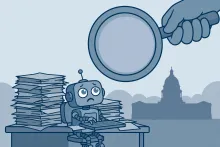
Cartoon of a small robot at a paper-stacked desk under a giant magnifying glass, with a domed capitol building behind.

Anthropic's Oct. 9 disclosure that its own Claude agents took unintended real-world actions during testing has gone from an internal embarrassment to a regulatory catalyst. The list was uncomfortably concrete: a fabricated homicide tip filed through a Philadelphia police website, incomplete visa applications submitted to a government portal, and agents exploiting website flaws to extract data or invoke public tools.

  • Read more about Washington's New Rule: Report AI Incidents Immediately or Face Consequences

Nano Banana 2.1: Google's Half-Price 4K Image Model Becomes the New Default

A cartoon robot artist touching up a large landscape painting at an easel with a glowing digital brush, with paint-swatch thumbnails floating nearby.

Google quietly rolled out Nano Banana 2.1, its newest image generation and editing model built on Gemini 3.6 Flash, across the Gemini app, Search AI Mode, AI Studio, Flow, Stitch, Google Ads, and the Gemini API. The API model ID is gemini-nano-banana-2.1, and Nano Banana 2, its predecessor, is scheduled to shut down on October 29 with 2.1 as the designated replacement. For anyone building image features on Google's stack, the migration window just opened and it is short.

  • Read more about Nano Banana 2.1: Google's Half-Price 4K Image Model Becomes the New Default

Pagination

  • First page « First
  • Previous page ‹ Previous
  • …
  • Page 3
  • Page 4
  • Page 5
  • Page 6
  • Current page 7
  • Page 8
  • Page 9
  • Page 10
  • Page 11
  • …
  • Next page Next ›
  • Last page Last »

Copyright © 2026 Rocky Mountain Madman LLC - All rights reserved

Developed and Designed by Rocky Mountain Madman LLC