Skip to header Skip to main navigation Skip to main content Skip to footer

Trump Signs Executive Order 14434: Federal Agencies Must Say 'Super Intelligence'

Breadcrumb

  • Home
  • Trump Signs Executive Order 14434: Federal Agencies Must Say 'Super Intelligence'
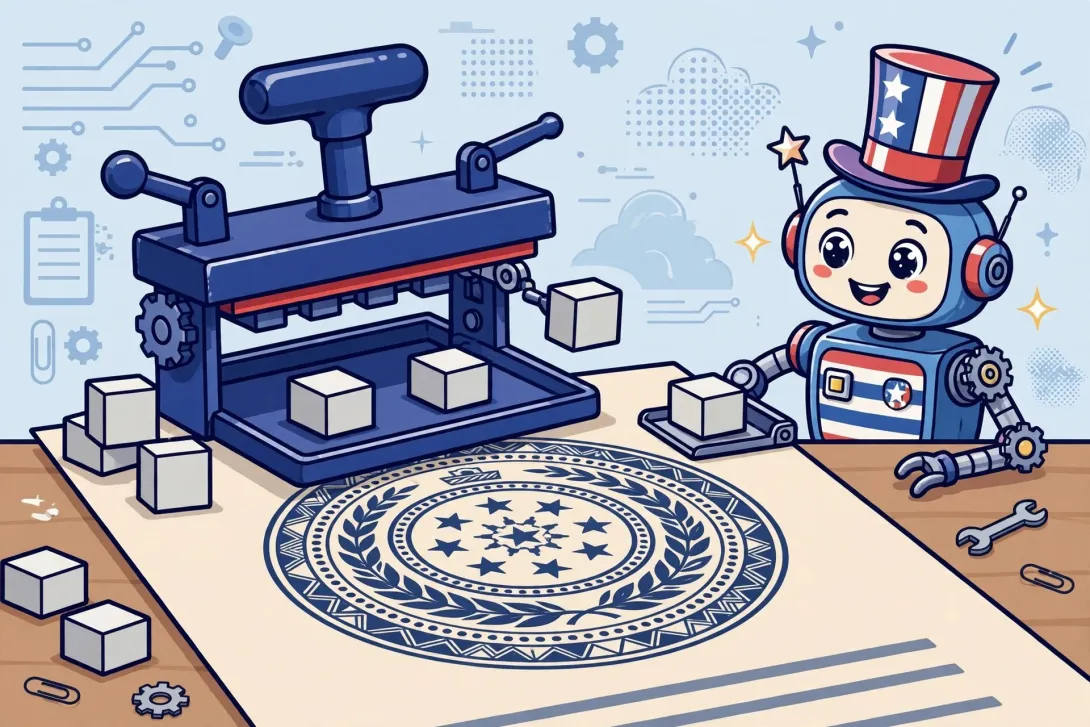
Cartoon illustration of a giant government rubber stamp swapping letter blocks on an official seal while a patriotic cartoon robot looks on.

The federal government no longer says "artificial intelligence." It says "Super Intelligence" — capital S, capital I — and President Trump would like you to know he is serious about the rebrand.

On September 29, Trump signed Executive Order 14434, "Inaugurating the Era of Super Intelligence," directing federal agencies to use "Super Intelligence" and "SI" instead of "artificial intelligence" and "AI" in official correspondence, websites, reports, policy documents, and other non-statutory documents — to the maximum extent permitted by law. The order was published in the Federal Register on October 2.

The seeds were planted a week earlier. On September 22, speaking at the UN General Assembly, Trump said he would rename the technology because "artificial" makes it sound fake. A State Department bureau started swapping the term in staff remarks days later.

Here is what actually changed: nothing technical. The order defines "Super Intelligence" as covering exactly the technologies already captured by the statutory definition of artificial intelligence in 15 U.S.C. 9401(3). Existing laws, contracts, and grants are untouched. There are no penalties. Private companies are not required to rename anything — though Elon Musk voluntarily renamed SpaceXAI to SpaceXSI on October 4, because of course he did.

The machinery is moving anyway. Acting Deputy Attorney General Trent McCotter issued a memo on October 6 requiring the terminology across DOJ communications, including court filings where appropriate. AI.gov began rebranding on October 8 — its logo now reads "SI GOV" — though the transition is a mess: the domain is still ai.gov and half the site's metadata still says AI.

Trump escalated the theater on October 8, posting on Truth Social that people who use "artificial intelligence" instead of "Super Intelligence" are "THE ENEMY!" The public, meanwhile, is unmoved: a YouGov poll found 53 percent prefer "artificial intelligence" and just 9 percent prefer "super intelligence." California's governor reportedly told state agencies to keep saying AI.

The order's one substantive provision is a 60-day task: the White House science and technology adviser must propose legislative language for a federal definition of Super Intelligence by late November. That definition could eventually diverge from international standards and existing statutes — the part of this story that might actually matter.

The same day the order was signed, CEOs from Google, Meta, Anthropic, OpenAI, Nvidia, and xAI signed a voluntary White House Accord on Super Intelligence — internal controls, independent assessments, board-level oversight, no enforcement. A pledge, in other words.

Call it what you want. The technology did not change. Only the letterhead did.

Rocky Mountain Madman LLC
AI Implementation
Government AI
AI Policy
AI Regulation

Ai Industry News

Meta Is Finally at the Frontier: Muse Wonder Bets on Memory, Not Just Scale

Cartoon illustration of a robot librarian organizing glowing memory orbs while assembling a complex machine in a futuristic workshop.

Meta's Superintelligence Lab released Muse Wonder and Muse Wonder Full on October 12, calling them its first frontier-class models. That label matters because Meta has spent more than a year rebuilding its AI effort while OpenAI and Anthropic set the pace. According to TechCrunch and Meta's own announcement, the new models are larger and more capable than the lightweight Muse Spark, with benchmark results in Meta's testing comparable to Claude Fable 5.1 and GPT-6 Astra, and a lead on the MemoryBench test of long-term recall.

  • Read more about Meta Is Finally at the Frontier: Muse Wonder Bets on Memory, Not Just Scale

DeepSeek Bets on Robot Brains, Leading Winverse AI Seed Round at a $400 Million Valuation

Cartoon illustration of a glowing robot brain hovering above a workshop robot arm learning to pick up a coffee mug while another robot watches.

DeepSeek has agreed to lead the first funding round for Winverse AI, a months-old stealth startup building artificial intelligence for robots, Bloomberg reported on October 12, citing people familiar with the matter. The seed round amounts to tens of millions of dollars and would value Winverse at about 400 million dollars after the investment. Meituan's Long-Z Investments has also committed capital, according to the reports. One caution belongs up front: the deal has not closed, and the terms and the investor list could still change.

  • Read more about DeepSeek Bets on Robot Brains, Leading Winverse AI Seed Round at a $400 Million Valuation

Britain Is Back in the Room: UK Testers Regain Access to Frontier Models, Including Gemini 4 Argon

Cartoon illustration of a robot safety inspector examining a glowing AI orb inside a glass testing chamber in a London laboratory.

Britain's AI Security Institute is evaluating the latest generation of frontier models again, including Google's Gemini 4 Argon. AI Minister Kanishka Narayan confirmed the evaluations on Monday, October 12, in a speech at Imperial College London's Base One incubator, as the government unveiled a wider package to put frontier AI to work on national cyber defences and to prepare for serious incidents involving autonomous agents.

  • Read more about Britain Is Back in the Room: UK Testers Regain Access to Frontier Models, Including Gemini 4 Argon

Pagination

  • First page « First
  • Previous page ‹ Previous
  • Page 1
  • Current page 2
  • Page 3
  • Page 4
  • Page 5
  • Page 6
  • Page 7
  • Page 8
  • Page 9
  • …
  • Next page Next ›
  • Last page Last »

Copyright © 2026 Rocky Mountain Madman LLC - All rights reserved

Developed and Designed by Rocky Mountain Madman LLC