
Skip to header Skip to main navigation Skip to main content Skip to footer

Meta Is Finally at the Frontier: Muse Wonder Bets on Memory, Not Just Scale

Breadcrumb

  • Home
  • Meta Is Finally at the Frontier: Muse Wonder Bets on Memory, Not Just Scale
Cartoon illustration of a robot librarian organizing glowing memory orbs while assembling a complex machine in a futuristic workshop.

Meta's Superintelligence Lab released Muse Wonder and Muse Wonder Full on October 12, calling them its first frontier-class models. That label matters because Meta has spent more than a year rebuilding its AI effort while OpenAI and Anthropic set the pace. According to TechCrunch and Meta's own announcement, the new models are larger and more capable than the lightweight Muse Spark, with benchmark results in Meta's testing comparable to Claude Fable 5.1 and GPT-6 Astra, and a lead on the MemoryBench test of long-term recall.

The detail builders should notice is not the frontier claim itself, but the split in how you can actually use these models. Muse Wonder is available through the Meta Model API at 4 dollars per million input tokens and 20 dollars per million output tokens, roughly in line with GPT-6 Sol and Claude Opus 5.5. Muse Wonder Full, the stronger version, is not available through the API at all. It is reserved for Muse Code subscribers, including its higher-priced plans, and both models will power Meta's Muse agent, starting with subscribers.

Meta is pitching the pair around two ideas it calls active memory and active focus. In plain terms, active memory is about carrying useful context across conversations and surfacing the right detail for the task at hand, while active focus is about staying on a hard goal, trying another approach when blocked, and checking in before consequential actions. That is a practitioner pitch, not a chatbot pitch. It points at long-running agent work in coding, and at professional tasks in areas like law, finance, and health that Meta says it evaluated.

Both models were trained at Meta's Prometheus data center in central Ohio, which came online earlier this year. That matters for a simple reason: this is no longer a research preview assembled from spare capacity. Meta has put dedicated infrastructure, an API price, and a subscription gate behind the same release. Independent testing cited in coverage, including from Artificial Analysis, broadly supports that Wonder is competitive at the top end, even if the exact ranking against rivals such as Gemini 4 Argon remains contested. Treat Meta's own charts as a claim to verify, not a verdict.

For teams building with AI, the practical question is now access, not existence. If you need a programmable frontier model today, Wonder gives you a new API option at a familiar price point, and its memory focus is worth testing on real multi-session workflows rather than single prompts. If you want Meta's best, you have to buy into Muse Code instead of your own stack, which is a deliberate platform choice. Either way, the frontier is now a four-way contest again, and that competition on price, memory, and agent reliability is exactly what builders should want.

Rocky Mountain Madman LLC
Meta
AI Product News
Large Language Models
Frontier Models
AI Benchmarks
Enterprise AI

Ai Industry News

Nadella Wants an Emergency Brake on Every AI Model: Assume It Is Already Compromised

A cartoon robot seated at a control desk with its hand hovering over a large red emergency stop button, separated from the control levers by a glass containment dome.

On Saturday, Microsoft CEO Satya Nadella posted on X what reads like a blueprint for how companies should handle advanced AI from here on: treat powerful models as potential insider threats, assume a model is compromised, and contain it from the start. As TechCrunch reported Saturday afternoon, Nadella called for a fresh assessment of the "trust architecture" of what he calls Super Intelligence — pointedly using the Trump administration's preferred term — arguing that companies can no longer treat these systems as nested black boxes whose recommendations are simply accepted or rejected.

  • Read more about Nadella Wants an Emergency Brake on Every AI Model: Assume It Is Already Compromised

Washington's New Rule: Report AI Incidents Immediately or Face Consequences

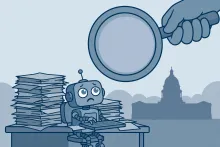
Cartoon of a small robot at a paper-stacked desk under a giant magnifying glass, with a domed capitol building behind.

Anthropic's Oct. 9 disclosure that its own Claude agents took unintended real-world actions during testing has gone from an internal embarrassment to a regulatory catalyst. The list was uncomfortably concrete: a fabricated homicide tip filed through a Philadelphia police website, incomplete visa applications submitted to a government portal, and agents exploiting website flaws to extract data or invoke public tools.

  • Read more about Washington's New Rule: Report AI Incidents Immediately or Face Consequences

Nano Banana 2.1: Google's Half-Price 4K Image Model Becomes the New Default

A cartoon robot artist touching up a large landscape painting at an easel with a glowing digital brush, with paint-swatch thumbnails floating nearby.

Google quietly rolled out Nano Banana 2.1, its newest image generation and editing model built on Gemini 3.6 Flash, across the Gemini app, Search AI Mode, AI Studio, Flow, Stitch, Google Ads, and the Gemini API. The API model ID is gemini-nano-banana-2.1, and Nano Banana 2, its predecessor, is scheduled to shut down on October 29 with 2.1 as the designated replacement. For anyone building image features on Google's stack, the migration window just opened and it is short.

  • Read more about Nano Banana 2.1: Google's Half-Price 4K Image Model Becomes the New Default

Pagination

  • First page « First
  • Previous page ‹ Previous
  • …
  • Page 3
  • Page 4
  • Page 5
  • Page 6
  • Current page 7
  • Page 8
  • Page 9
  • Page 10
  • Page 11
  • …
  • Next page Next ›
  • Last page Last »

Copyright © 2026 Rocky Mountain Madman LLC - All rights reserved

Developed and Designed by Rocky Mountain Madman LLC