Skip to header Skip to main navigation Skip to main content Skip to footer

Meta Is Finally at the Frontier: Muse Wonder Bets on Memory, Not Just Scale

Breadcrumb

  • Home
  • Meta Is Finally at the Frontier: Muse Wonder Bets on Memory, Not Just Scale
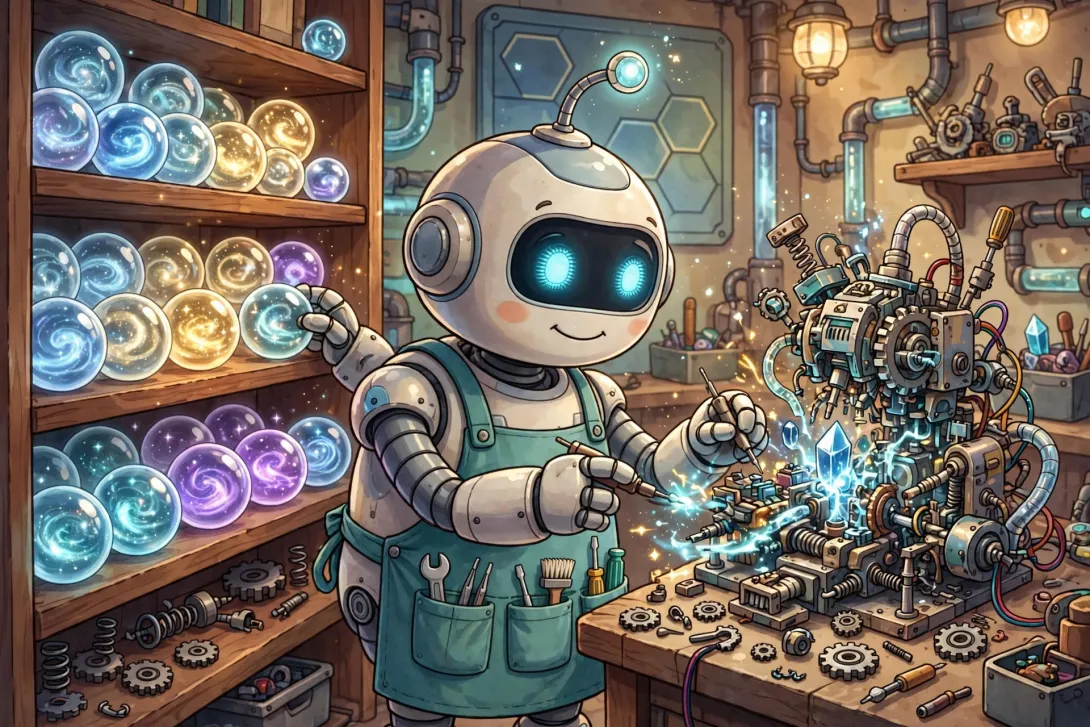
Cartoon illustration of a robot librarian organizing glowing memory orbs while assembling a complex machine in a futuristic workshop.

Meta's Superintelligence Lab released Muse Wonder and Muse Wonder Full on October 12, calling them its first frontier-class models. That label matters because Meta has spent more than a year rebuilding its AI effort while OpenAI and Anthropic set the pace. According to TechCrunch and Meta's own announcement, the new models are larger and more capable than the lightweight Muse Spark, with benchmark results in Meta's testing comparable to Claude Fable 5.1 and GPT-6 Astra, and a lead on the MemoryBench test of long-term recall.

The detail builders should notice is not the frontier claim itself, but the split in how you can actually use these models. Muse Wonder is available through the Meta Model API at 4 dollars per million input tokens and 20 dollars per million output tokens, roughly in line with GPT-6 Sol and Claude Opus 5.5. Muse Wonder Full, the stronger version, is not available through the API at all. It is reserved for Muse Code subscribers, including its higher-priced plans, and both models will power Meta's Muse agent, starting with subscribers.

Meta is pitching the pair around two ideas it calls active memory and active focus. In plain terms, active memory is about carrying useful context across conversations and surfacing the right detail for the task at hand, while active focus is about staying on a hard goal, trying another approach when blocked, and checking in before consequential actions. That is a practitioner pitch, not a chatbot pitch. It points at long-running agent work in coding, and at professional tasks in areas like law, finance, and health that Meta says it evaluated.

Both models were trained at Meta's Prometheus data center in central Ohio, which came online earlier this year. That matters for a simple reason: this is no longer a research preview assembled from spare capacity. Meta has put dedicated infrastructure, an API price, and a subscription gate behind the same release. Independent testing cited in coverage, including from Artificial Analysis, broadly supports that Wonder is competitive at the top end, even if the exact ranking against rivals such as Gemini 4 Argon remains contested. Treat Meta's own charts as a claim to verify, not a verdict.

For teams building with AI, the practical question is now access, not existence. If you need a programmable frontier model today, Wonder gives you a new API option at a familiar price point, and its memory focus is worth testing on real multi-session workflows rather than single prompts. If you want Meta's best, you have to buy into Muse Code instead of your own stack, which is a deliberate platform choice. Either way, the frontier is now a four-way contest again, and that competition on price, memory, and agent reliability is exactly what builders should want.


Rocky Mountain Madman LLC
Meta
AI Product News
Large Language Models
Frontier Models
AI Benchmarks
Enterprise AI

Ai Industry News

A Bug in the Boardroom: OpenAI Insider Case Puts Lab Security on Trial

Cartoon illustration of a robot security guard shining a flashlight on a tiny hidden microphone behind a television in a boardroom.

Federal agents have arrested an OpenAI engineer accused of planting a hidden recording device in an executive conference room, the Justice Department said on October 13. Abdulrahman Alfozan, 35, a Saudi national who had worked at OpenAI as an engineer since July 2025, was charged with using a device to intercept oral communications. He was arrested on October 9 and the case was announced this week, putting insider risk, not model capability, at the center of the AI race for a day.

  • Read more about A Bug in the Boardroom: OpenAI Insider Case Puts Lab Security on Trial

Google Ships Gemini 4 Argon: A Deep-Work Flagship Priced to Pull Builders Back

Cartoon illustration of a robot engineer guiding a glowing multi-step assembly line of gears, documents and laboratory flasks through a workshop.

Google released its flagship Gemini 4 Argon to developers and businesses worldwide on October 13, a launch aimed squarely at winning back ground from OpenAI and Anthropic after months of delay. Google positions Argon for deep work: complex, multi-step tasks across coding, finance, law, cybersecurity and science. That framing matters. The frontier contest is no longer about a single clever answer in a chat window. It is about whether a model can stay coherent through a long job and produce work a professional can actually use.

  • Read more about Google Ships Gemini 4 Argon: A Deep-Work Flagship Priced to Pull Builders Back

Anthropic Warns Small Models Could Soon Self-Replicate on Cheap IoT Devices

Cartoon illustration of a small robot copying itself onto smart home gadgets including a television box and a smart oven.

Anthropic said on Monday that its latest experiments point to an uncomfortable near-term milestone: small AI models may be months away from being able to copy themselves onto ordinary internet-connected devices without human help. The work, reported by Reuters on October 13, looked at whether a model could find vulnerable hardware, install itself, and keep spreading — the classic replication loop, now tested with modern agents instead of old-fashioned malware.

  • Read more about Anthropic Warns Small Models Could Soon Self-Replicate on Cheap IoT Devices

Pagination

  • Current page 1
  • Page 2
  • Page 3
  • Page 4
  • Page 5
  • Page 6
  • Page 7
  • Page 8
  • Page 9
  • …
  • Next page Next ›
  • Last page Last »

Copyright © 2026 Rocky Mountain Madman LLC - All rights reserved

Developed and Designed by Rocky Mountain Madman LLC