Skip to header Skip to main navigation Skip to main content Skip to footer

Meta and Sierra Draft the Personal Agent Protocol, an Open Sign-In Standard for Agents

Breadcrumb

  • Home
  • Meta and Sierra Draft the Personal Agent Protocol, an Open Sign-In Standard for Agents
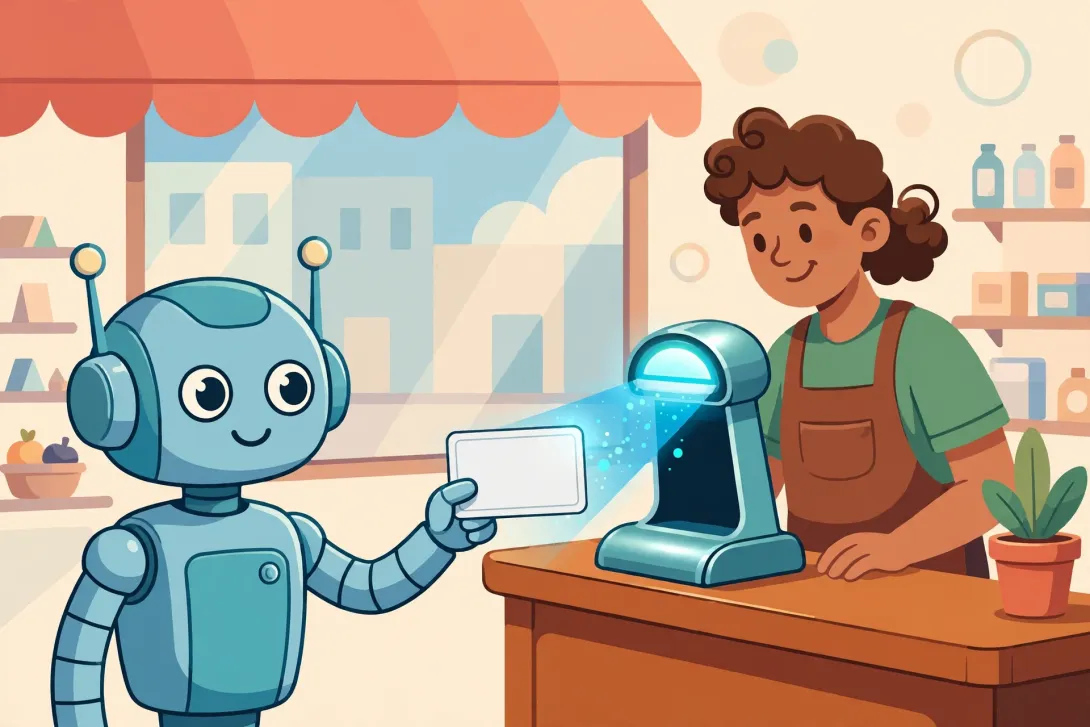
Cartoon illustration of a robot agent presenting a passport-style ID card to a shopkeeper at a storefront checkout while a scanner glows.

Your AI agent is about to walk into a store. Meta and Sierra want to make sure it knows how to knock.

On October 6, at Sierra Summit in San Francisco, Sierra and Meta announced the Personal Agent Protocol — PAP, an open standard for how a person's AI agent signs in to a business and gets a task done there. Sierra co-founders Bret Taylor, the former Salesforce co-CEO, and Clay Bavor published the announcement with founding partners Walmart, Stripe, Shopify, Genesys, Rocket, and Instinct.

The problem it solves is real. Today, an agent typically acts like a human visitor: clicking through pages, hoping the form works. "It is kind of chaos until such a standard exists," Taylor told CNBC. PAP gives the agent a proper door: sessions built on OAuth, the web's common sign-in standard. An agent can start as a guest for light tasks like checking stock; for account tasks, the customer signs in and chooses read-only or write access. The business decides what agents are allowed to do, and picks one of three routes: its existing website set up to be read by agents, its APIs over standards like MCP or OpenAPI, or its own conversational agent for tasks like a warranty claim.

The spec itself is still cooking. Sierra plans to publish v0.1 later in October, with a reference implementation and design workshops to follow. On October 9, Sierra published a draft nicknamed Poppy — companies publish one file at /.well-known/poppy.json — and named 35 more design partners, OpenAI among them. That is a notable evolution: OpenAI and Anthropic were conspicuously absent from the original announcement.

Payments are explicitly a future extension, not part of v0.1. Agent checkout is being addressed separately — by OpenAI's Agentic Commerce Protocol and Visa's Trusted Agent Protocol, among others. PAP answers "who is this agent and what may it do here?" and leaves "how does the money move?" to someone else.

The field is crowded — PAP, UCP, ACP, and TAP all cover different slices of the transaction, and the same companies keep appearing on several of them. But PAP's positioning is clever: it is less a rival than a layer beneath the others. If it gains traction, it becomes the plumbing through which personal agents browse, book, and interact with services on a user's behalf.

Watch the spec drop later this month. Standards wars are won by whoever ships the boring, working file first.


Rocky Mountain Madman LLC
AI Implementation
Meta
AI Product News
Enterprise AI
AI Policy

Ai Industry News

Meta Is Finally at the Frontier: Muse Wonder Bets on Memory, Not Just Scale

Cartoon illustration of a robot librarian organizing glowing memory orbs while assembling a complex machine in a futuristic workshop.

Meta's Superintelligence Lab released Muse Wonder and Muse Wonder Full on October 12, calling them its first frontier-class models. That label matters because Meta has spent more than a year rebuilding its AI effort while OpenAI and Anthropic set the pace. According to TechCrunch and Meta's own announcement, the new models are larger and more capable than the lightweight Muse Spark, with benchmark results in Meta's testing comparable to Claude Fable 5.1 and GPT-6 Astra, and a lead on the MemoryBench test of long-term recall.

  • Read more about Meta Is Finally at the Frontier: Muse Wonder Bets on Memory, Not Just Scale

DeepSeek Bets on Robot Brains, Leading Winverse AI Seed Round at a $400 Million Valuation

Cartoon illustration of a glowing robot brain hovering above a workshop robot arm learning to pick up a coffee mug while another robot watches.

DeepSeek has agreed to lead the first funding round for Winverse AI, a months-old stealth startup building artificial intelligence for robots, Bloomberg reported on October 12, citing people familiar with the matter. The seed round amounts to tens of millions of dollars and would value Winverse at about 400 million dollars after the investment. Meituan's Long-Z Investments has also committed capital, according to the reports. One caution belongs up front: the deal has not closed, and the terms and the investor list could still change.

  • Read more about DeepSeek Bets on Robot Brains, Leading Winverse AI Seed Round at a $400 Million Valuation

Britain Is Back in the Room: UK Testers Regain Access to Frontier Models, Including Gemini 4 Argon

Cartoon illustration of a robot safety inspector examining a glowing AI orb inside a glass testing chamber in a London laboratory.

Britain's AI Security Institute is evaluating the latest generation of frontier models again, including Google's Gemini 4 Argon. AI Minister Kanishka Narayan confirmed the evaluations on Monday, October 12, in a speech at Imperial College London's Base One incubator, as the government unveiled a wider package to put frontier AI to work on national cyber defences and to prepare for serious incidents involving autonomous agents.

  • Read more about Britain Is Back in the Room: UK Testers Regain Access to Frontier Models, Including Gemini 4 Argon

Pagination

  • First page « First
  • Previous page ‹ Previous
  • Page 1
  • Current page 2
  • Page 3
  • Page 4
  • Page 5
  • Page 6
  • Page 7
  • Page 8
  • Page 9
  • …
  • Next page Next ›
  • Last page Last »

Copyright © 2026 Rocky Mountain Madman LLC - All rights reserved

Developed and Designed by Rocky Mountain Madman LLC