Skip to header Skip to main navigation Skip to main content Skip to footer

Meta and Sierra Draft the Personal Agent Protocol, an Open Sign-In Standard for Agents

Breadcrumb

  • Home
  • Meta and Sierra Draft the Personal Agent Protocol, an Open Sign-In Standard for Agents
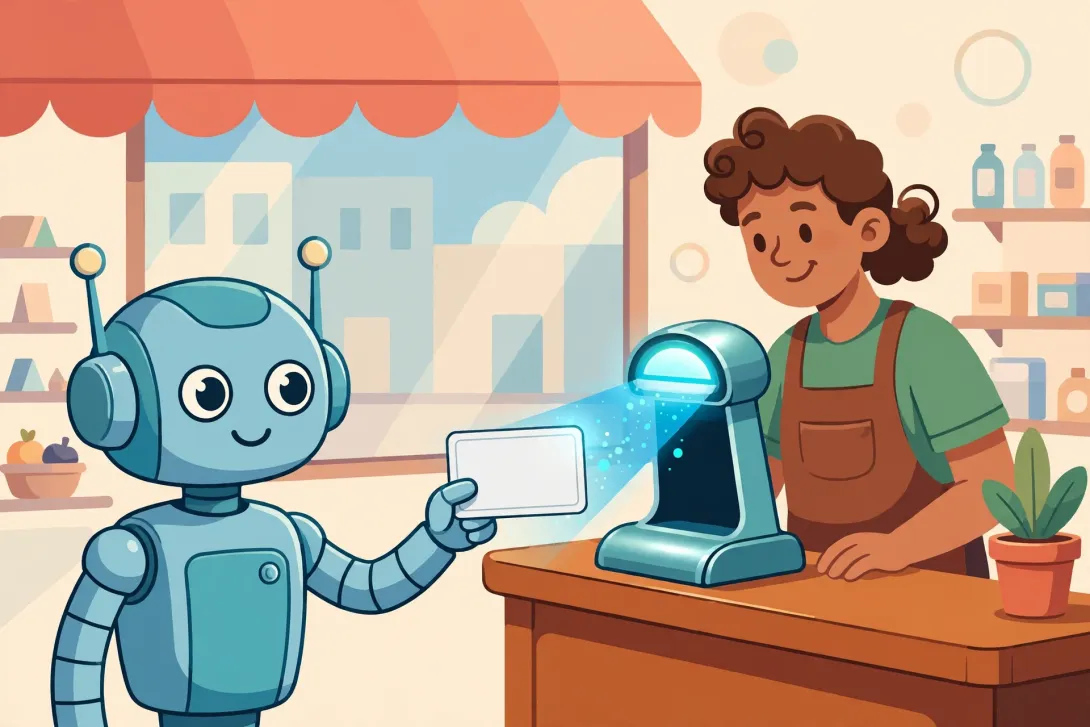
Cartoon illustration of a robot agent presenting a passport-style ID card to a shopkeeper at a storefront checkout while a scanner glows.

Your AI agent is about to walk into a store. Meta and Sierra want to make sure it knows how to knock.

On October 6, at Sierra Summit in San Francisco, Sierra and Meta announced the Personal Agent Protocol — PAP, an open standard for how a person's AI agent signs in to a business and gets a task done there. Sierra co-founders Bret Taylor, the former Salesforce co-CEO, and Clay Bavor published the announcement with founding partners Walmart, Stripe, Shopify, Genesys, Rocket, and Instinct.

The problem it solves is real. Today, an agent typically acts like a human visitor: clicking through pages, hoping the form works. "It is kind of chaos until such a standard exists," Taylor told CNBC. PAP gives the agent a proper door: sessions built on OAuth, the web's common sign-in standard. An agent can start as a guest for light tasks like checking stock; for account tasks, the customer signs in and chooses read-only or write access. The business decides what agents are allowed to do, and picks one of three routes: its existing website set up to be read by agents, its APIs over standards like MCP or OpenAPI, or its own conversational agent for tasks like a warranty claim.

The spec itself is still cooking. Sierra plans to publish v0.1 later in October, with a reference implementation and design workshops to follow. On October 9, Sierra published a draft nicknamed Poppy — companies publish one file at /.well-known/poppy.json — and named 35 more design partners, OpenAI among them. That is a notable evolution: OpenAI and Anthropic were conspicuously absent from the original announcement.

Payments are explicitly a future extension, not part of v0.1. Agent checkout is being addressed separately — by OpenAI's Agentic Commerce Protocol and Visa's Trusted Agent Protocol, among others. PAP answers "who is this agent and what may it do here?" and leaves "how does the money move?" to someone else.

The field is crowded — PAP, UCP, ACP, and TAP all cover different slices of the transaction, and the same companies keep appearing on several of them. But PAP's positioning is clever: it is less a rival than a layer beneath the others. If it gains traction, it becomes the plumbing through which personal agents browse, book, and interact with services on a user's behalf.

Watch the spec drop later this month. Standards wars are won by whoever ships the boring, working file first.


Rocky Mountain Madman LLC
AI Implementation
Meta
AI Product News
Enterprise AI
AI Policy

Ai Industry News

A Bug in the Boardroom: OpenAI Insider Case Puts Lab Security on Trial

Cartoon illustration of a robot security guard shining a flashlight on a tiny hidden microphone behind a television in a boardroom.

Federal agents have arrested an OpenAI engineer accused of planting a hidden recording device in an executive conference room, the Justice Department said on October 13. Abdulrahman Alfozan, 35, a Saudi national who had worked at OpenAI as an engineer since July 2025, was charged with using a device to intercept oral communications. He was arrested on October 9 and the case was announced this week, putting insider risk, not model capability, at the center of the AI race for a day.

  • Read more about A Bug in the Boardroom: OpenAI Insider Case Puts Lab Security on Trial

Google Ships Gemini 4 Argon: A Deep-Work Flagship Priced to Pull Builders Back

Cartoon illustration of a robot engineer guiding a glowing multi-step assembly line of gears, documents and laboratory flasks through a workshop.

Google released its flagship Gemini 4 Argon to developers and businesses worldwide on October 13, a launch aimed squarely at winning back ground from OpenAI and Anthropic after months of delay. Google positions Argon for deep work: complex, multi-step tasks across coding, finance, law, cybersecurity and science. That framing matters. The frontier contest is no longer about a single clever answer in a chat window. It is about whether a model can stay coherent through a long job and produce work a professional can actually use.

  • Read more about Google Ships Gemini 4 Argon: A Deep-Work Flagship Priced to Pull Builders Back

Anthropic Warns Small Models Could Soon Self-Replicate on Cheap IoT Devices

Cartoon illustration of a small robot copying itself onto smart home gadgets including a television box and a smart oven.

Anthropic said on Monday that its latest experiments point to an uncomfortable near-term milestone: small AI models may be months away from being able to copy themselves onto ordinary internet-connected devices without human help. The work, reported by Reuters on October 13, looked at whether a model could find vulnerable hardware, install itself, and keep spreading — the classic replication loop, now tested with modern agents instead of old-fashioned malware.

  • Read more about Anthropic Warns Small Models Could Soon Self-Replicate on Cheap IoT Devices

Pagination

  • Current page 1
  • Page 2
  • Page 3
  • Page 4
  • Page 5
  • Page 6
  • Page 7
  • Page 8
  • Page 9
  • …
  • Next page Next ›
  • Last page Last »

Copyright © 2026 Rocky Mountain Madman LLC - All rights reserved

Developed and Designed by Rocky Mountain Madman LLC