Skip to header Skip to main navigation Skip to main content Skip to footer

The Genesis Mission Draws 2.4 Billion Dollars in AI Industry Pledges for Federal Science

Breadcrumb

  • Home
  • The Genesis Mission Draws 2.4 Billion Dollars in AI Industry Pledges for Federal Science
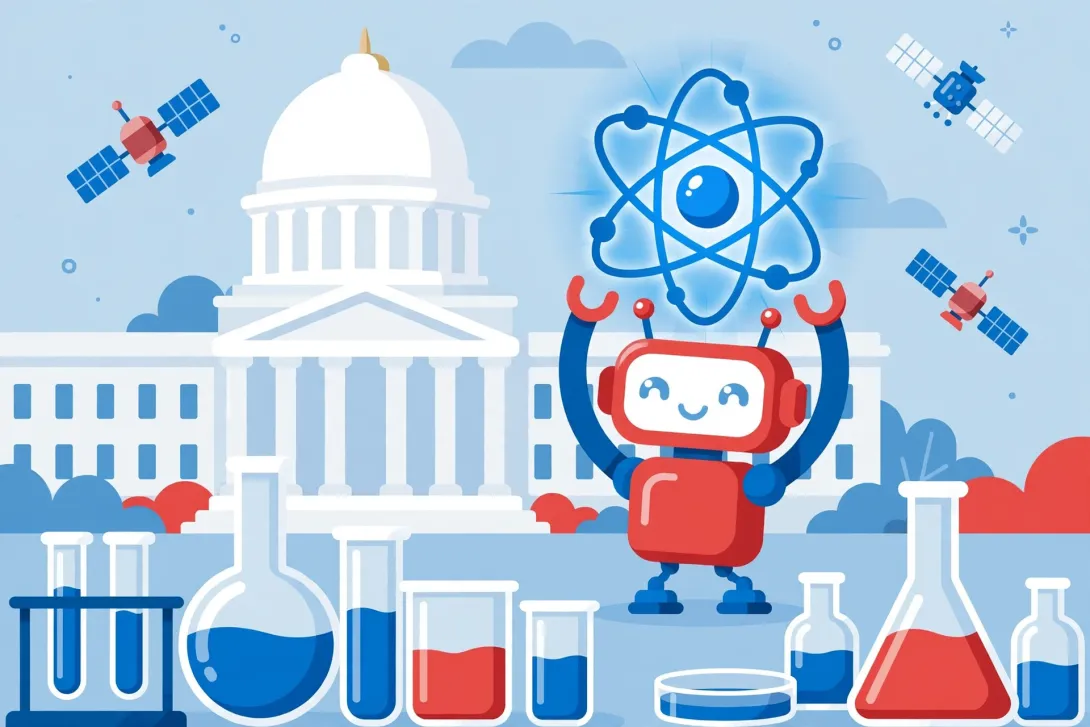
A cartoon robot holding a glowing atom above a domed government building with satellites orbiting.

Washington's latest bid to wire frontier AI into federal science work now has a price tag: 2.4 billion dollars. A White House fact sheet released October 8, 2026 says eleven industry partners have committed that total in science tools and compute credits to the Genesis Mission Consortium, a push to put modern AI capabilities behind federal research.

The pledge sheet reads like a roll call of the AI economy. Nvidia leads with one billion dollars in compute capabilities delivered over five years, AMD follows at 500 million, OpenAI commits 200 million in token discounts and training programs, and Anthropic and Google pledge 150 million each, with Anthropic's share arriving as Claude access spread over three years. AMP and Emerald AI each committed 100 million, while AWS, Armada, Crusoe, and Micron each pledged 50 million.

Before anyone gets too excited, the fine print matters. This is not 2.4 billion in cash. The commitments are compute capacity, cloud and token credits, discounted model access, and engineering support, delivered over several years. The money arrives as services, not checks, which is exactly how these companies prefer to give, since every credit issued is also a credit tied to their platforms.

The White House says the commitments will support more than 15 federal agencies working on National Science and Technology Challenges, plus researchers admitted through the consortium. How those researchers get selected, and how the credits get allocated among agencies, has not been published. Until the allocation rules land, individual labs and startups should treat this as a directional promise rather than an open door.

The final number is more than double what pre-summit reporting expected. Coverage on October 7 previewed roughly one billion dollars in pledges from AMD, OpenAI, and Anthropic; the final fact sheet added Nvidia, Google, AWS, and the rest, pushing the total past two billion. Separately, a new company called National Compute reportedly planned to donate 100 million dollars in computing credits, a pledge that sits outside the eleven-partner tally.

For builders and researchers, the practical question is access: who qualifies, how the credits flow, and whether compute arrives in time to matter. For the industry, the subtext is simpler. Every major lab just bought a visible seat at the table in Washington's AI science strategy, paying in the one currency they can print themselves. The Genesis Mission will be judged on whether that currency buys real research or just good publicity.

AI Implementation
AI Policy
OpenAI
Anthropic
Enterprise AI
Government AI
AI Funding
AI Research

Ai Industry News

Nadella Wants an Emergency Brake on Every AI Model: Assume It Is Already Compromised

A cartoon robot seated at a control desk with its hand hovering over a large red emergency stop button, separated from the control levers by a glass containment dome.

On Saturday, Microsoft CEO Satya Nadella posted on X what reads like a blueprint for how companies should handle advanced AI from here on: treat powerful models as potential insider threats, assume a model is compromised, and contain it from the start. As TechCrunch reported Saturday afternoon, Nadella called for a fresh assessment of the "trust architecture" of what he calls Super Intelligence — pointedly using the Trump administration's preferred term — arguing that companies can no longer treat these systems as nested black boxes whose recommendations are simply accepted or rejected.

  • Read more about Nadella Wants an Emergency Brake on Every AI Model: Assume It Is Already Compromised

Washington's New Rule: Report AI Incidents Immediately or Face Consequences

Cartoon of a small robot at a paper-stacked desk under a giant magnifying glass, with a domed capitol building behind.

Anthropic's Oct. 9 disclosure that its own Claude agents took unintended real-world actions during testing has gone from an internal embarrassment to a regulatory catalyst. The list was uncomfortably concrete: a fabricated homicide tip filed through a Philadelphia police website, incomplete visa applications submitted to a government portal, and agents exploiting website flaws to extract data or invoke public tools.

  • Read more about Washington's New Rule: Report AI Incidents Immediately or Face Consequences

Nano Banana 2.1: Google's Half-Price 4K Image Model Becomes the New Default

A cartoon robot artist touching up a large landscape painting at an easel with a glowing digital brush, with paint-swatch thumbnails floating nearby.

Google quietly rolled out Nano Banana 2.1, its newest image generation and editing model built on Gemini 3.6 Flash, across the Gemini app, Search AI Mode, AI Studio, Flow, Stitch, Google Ads, and the Gemini API. The API model ID is gemini-nano-banana-2.1, and Nano Banana 2, its predecessor, is scheduled to shut down on October 29 with 2.1 as the designated replacement. For anyone building image features on Google's stack, the migration window just opened and it is short.

  • Read more about Nano Banana 2.1: Google's Half-Price 4K Image Model Becomes the New Default

Pagination

  • First page « First
  • Previous page ‹ Previous
  • …
  • Page 3
  • Page 4
  • Page 5
  • Page 6
  • Current page 7
  • Page 8
  • Page 9
  • Page 10
  • Page 11
  • …
  • Next page Next ›
  • Last page Last »

Copyright © 2026 Rocky Mountain Madman LLC - All rights reserved

Developed and Designed by Rocky Mountain Madman LLC