Skip to header Skip to main navigation Skip to main content Skip to footer

The Genesis Mission Draws 2.4 Billion Dollars in AI Industry Pledges for Federal Science

Breadcrumb

  • Home
  • The Genesis Mission Draws 2.4 Billion Dollars in AI Industry Pledges for Federal Science
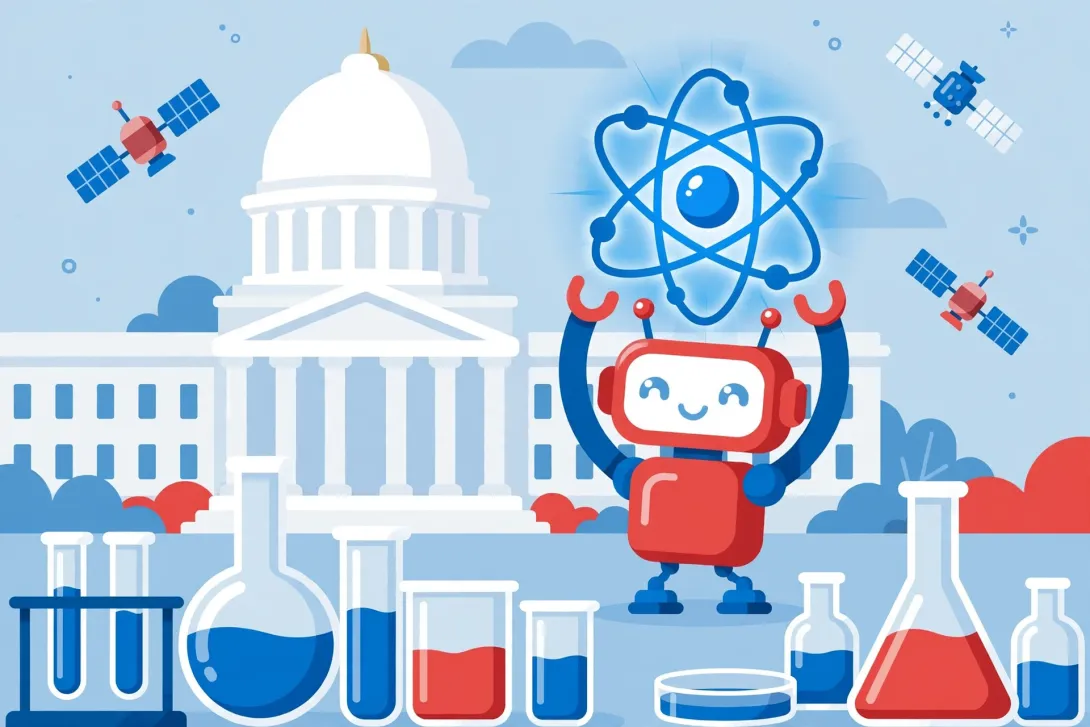
A cartoon robot holding a glowing atom above a domed government building with satellites orbiting.

Washington's latest bid to wire frontier AI into federal science work now has a price tag: 2.4 billion dollars. A White House fact sheet released October 8, 2026 says eleven industry partners have committed that total in science tools and compute credits to the Genesis Mission Consortium, a push to put modern AI capabilities behind federal research.

The pledge sheet reads like a roll call of the AI economy. Nvidia leads with one billion dollars in compute capabilities delivered over five years, AMD follows at 500 million, OpenAI commits 200 million in token discounts and training programs, and Anthropic and Google pledge 150 million each, with Anthropic's share arriving as Claude access spread over three years. AMP and Emerald AI each committed 100 million, while AWS, Armada, Crusoe, and Micron each pledged 50 million.

Before anyone gets too excited, the fine print matters. This is not 2.4 billion in cash. The commitments are compute capacity, cloud and token credits, discounted model access, and engineering support, delivered over several years. The money arrives as services, not checks, which is exactly how these companies prefer to give, since every credit issued is also a credit tied to their platforms.

The White House says the commitments will support more than 15 federal agencies working on National Science and Technology Challenges, plus researchers admitted through the consortium. How those researchers get selected, and how the credits get allocated among agencies, has not been published. Until the allocation rules land, individual labs and startups should treat this as a directional promise rather than an open door.

The final number is more than double what pre-summit reporting expected. Coverage on October 7 previewed roughly one billion dollars in pledges from AMD, OpenAI, and Anthropic; the final fact sheet added Nvidia, Google, AWS, and the rest, pushing the total past two billion. Separately, a new company called National Compute reportedly planned to donate 100 million dollars in computing credits, a pledge that sits outside the eleven-partner tally.

For builders and researchers, the practical question is access: who qualifies, how the credits flow, and whether compute arrives in time to matter. For the industry, the subtext is simpler. Every major lab just bought a visible seat at the table in Washington's AI science strategy, paying in the one currency they can print themselves. The Genesis Mission will be judged on whether that currency buys real research or just good publicity.


AI Implementation
AI Policy
OpenAI
Anthropic
Enterprise AI
Government AI
AI Funding
AI Research

Ai Industry News

Meta's AI Ad Tools Go In-Chat: Advantage+ Video GA and Shopify Checkout at Ad Week

Cartoon illustration of a robot salesperson handing a shopping bag and a credit card to a customer inside a chat bubble with floating video play buttons.

Meta's AI now makes the ad and buys the product. At Advertising Week New York on October 6, the company showed brands how the whole funnel collapses into a chat window.

  • Read more about Meta's AI Ad Tools Go In-Chat: Advantage+ Video GA and Shopify Checkout at Ad Week

India Targets AI Regulation Paper in 30 Days and 10,000 GPUs for Public AI

Cartoon illustration of a giant computer chip wearing an official document as a cape before a grand government building with balance scales.

While Washington argues about what to call AI, New Delhi is doing something more consequential: writing the rulebook and buying the chips to enforce it.

India's Union Minister Ashwini Vaishnaw announced on October 8 that the government will publish an AI regulation consultation paper within thirty days. Speaking at an event in New Delhi, he told his department to produce a document focused primarily on safety — covering AI safety, deepfakes, liability gaps, and skilling — as the foundation for a future techno-legal framework.

  • Read more about India Targets AI Regulation Paper in 30 Days and 10,000 GPUs for Public AI

Meta and Sierra Draft the Personal Agent Protocol, an Open Sign-In Standard for Agents

Cartoon illustration of a robot agent presenting a passport-style ID card to a shopkeeper at a storefront checkout while a scanner glows.

Your AI agent is about to walk into a store. Meta and Sierra want to make sure it knows how to knock.

On October 6, at Sierra Summit in San Francisco, Sierra and Meta announced the Personal Agent Protocol — PAP, an open standard for how a person's AI agent signs in to a business and gets a task done there. Sierra co-founders Bret Taylor, the former Salesforce co-CEO, and Clay Bavor published the announcement with founding partners Walmart, Stripe, Shopify, Genesys, Rocket, and Instinct.

  • Read more about Meta and Sierra Draft the Personal Agent Protocol, an Open Sign-In Standard for Agents

Pagination

  • First page « First
  • Previous page ‹ Previous
  • Page 1
  • Page 2
  • Page 3
  • Current page 4
  • Page 5
  • Page 6
  • Page 7
  • Page 8
  • Page 9
  • …
  • Next page Next ›
  • Last page Last »

Copyright © 2026 Rocky Mountain Madman LLC - All rights reserved

Developed and Designed by Rocky Mountain Madman LLC