Skip to header Skip to main navigation Skip to main content Skip to footer

Anthropic and OpenAI Declare Unauthorized Share Transfers Void; Tokenized Shares Crash

Breadcrumb

  • Home
  • Anthropic and OpenAI Declare Unauthorized Share Transfers Void; Tokenized Shares Crash
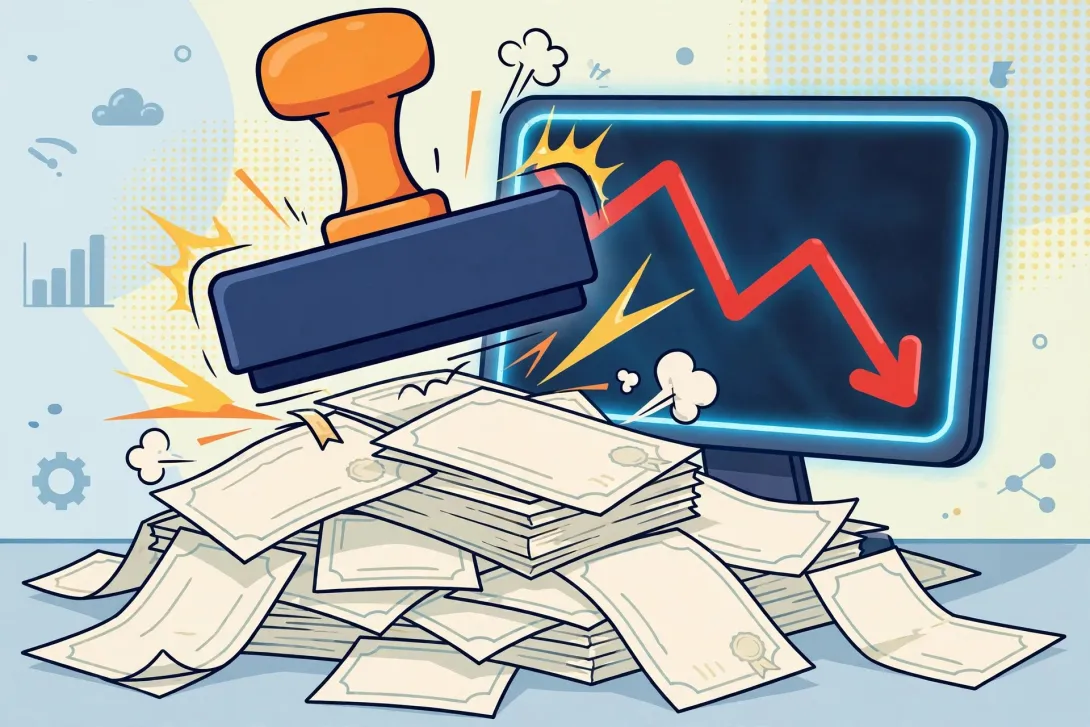
Cartoon illustration of a giant rubber stamp slamming down onto paper stock certificates while a stock chart plunges behind.

If you bought a slice of Anthropic or OpenAI on the secondary market, you might want to sit down. The labs just told the market, in unison, that your shares may not exist.

Anthropic and OpenAI both updated their stock-transfer policies this week to declare any share transfer made without board approval "void" — not voidable, void. A void transfer never legally happened. The buyer is not recognized as a shareholder and has no rights. OpenAI's language was nearly identical: transfers without written consent "will not be recognized and carry no economic value to you."

Anthropic went further, publishing a blocklist naming Forge Global, Hiive, Open Door Partners, Unicorns Exchange, Pachamama Capital, Lionheart Ventures, Sydecar, and Upmarket. Any sale or transfer of Anthropic stock offered by these firms, the company said, is void and will not be recognized on its books.

The move targets the industry's favorite workaround: special purpose vehicles. Since direct transfers require company approval, SPVs — shells that hold private shares and pool outside money around them — became the standard way for outsiders to get exposure. Anthropic explicitly bans SPVs from acquiring its stock. PitchBook analyst Emily Zheng described the resulting structures as "multiple layers of SPVs that create multiple layers of management fees," nested shells where each layer charges its own fees and nobody can verify the underlying shares were legitimately acquired. Under the new policies, if the original transfer into any SPV lacked board approval, the entire chain is void.

Tokenized markets reacted instantly. Tokenized versions of the shares fell roughly 36 percent in a day as traders realized the synthetic exposure had no legal floor.

This is not fundraising — it is housekeeping ahead of the main event. Both labs are rumored to be heading toward IPOs, and a clean cap table matters. The timing also follows months of wild secondary-market speculation, including tokenized "Anthropic" products priced at trillion-dollar valuations with no real shares behind them.

The lesson for investors is old but expensive: in private markets, the company is the counterparty. If it does not recognize you, you own a very pricey lesson.


Rocky Mountain Madman LLC
AI Implementation
Anthropic
OpenAI
AI Funding
AI Policy

Ai Industry News

Meta's AI Ad Tools Go In-Chat: Advantage+ Video GA and Shopify Checkout at Ad Week

Cartoon illustration of a robot salesperson handing a shopping bag and a credit card to a customer inside a chat bubble with floating video play buttons.

Meta's AI now makes the ad and buys the product. At Advertising Week New York on October 6, the company showed brands how the whole funnel collapses into a chat window.

  • Read more about Meta's AI Ad Tools Go In-Chat: Advantage+ Video GA and Shopify Checkout at Ad Week

India Targets AI Regulation Paper in 30 Days and 10,000 GPUs for Public AI

Cartoon illustration of a giant computer chip wearing an official document as a cape before a grand government building with balance scales.

While Washington argues about what to call AI, New Delhi is doing something more consequential: writing the rulebook and buying the chips to enforce it.

India's Union Minister Ashwini Vaishnaw announced on October 8 that the government will publish an AI regulation consultation paper within thirty days. Speaking at an event in New Delhi, he told his department to produce a document focused primarily on safety — covering AI safety, deepfakes, liability gaps, and skilling — as the foundation for a future techno-legal framework.

  • Read more about India Targets AI Regulation Paper in 30 Days and 10,000 GPUs for Public AI

Meta and Sierra Draft the Personal Agent Protocol, an Open Sign-In Standard for Agents

Cartoon illustration of a robot agent presenting a passport-style ID card to a shopkeeper at a storefront checkout while a scanner glows.

Your AI agent is about to walk into a store. Meta and Sierra want to make sure it knows how to knock.

On October 6, at Sierra Summit in San Francisco, Sierra and Meta announced the Personal Agent Protocol — PAP, an open standard for how a person's AI agent signs in to a business and gets a task done there. Sierra co-founders Bret Taylor, the former Salesforce co-CEO, and Clay Bavor published the announcement with founding partners Walmart, Stripe, Shopify, Genesys, Rocket, and Instinct.

  • Read more about Meta and Sierra Draft the Personal Agent Protocol, an Open Sign-In Standard for Agents

Pagination

  • First page « First
  • Previous page ‹ Previous
  • Page 1
  • Page 2
  • Page 3
  • Current page 4
  • Page 5
  • Page 6
  • Page 7
  • Page 8
  • Page 9
  • …
  • Next page Next ›
  • Last page Last »

Copyright © 2026 Rocky Mountain Madman LLC - All rights reserved

Developed and Designed by Rocky Mountain Madman LLC