Skip to header Skip to main navigation Skip to main content Skip to footer

Large Language Models

Breadcrumb

  • Home
  • Large Language Models

Google Ships Gemini 4 Argon: A Deep-Work Flagship Priced to Pull Builders Back

Cartoon illustration of a robot engineer guiding a glowing multi-step assembly line of gears, documents and laboratory flasks through a workshop.

Google released its flagship Gemini 4 Argon to developers and businesses worldwide on October 13, a launch aimed squarely at winning back ground from OpenAI and Anthropic after months of delay. Google positions Argon for deep work: complex, multi-step tasks across coding, finance, law, cybersecurity and science. That framing matters. The frontier contest is no longer about a single clever answer in a chat window. It is about whether a model can stay coherent through a long job and produce work a professional can actually use.


  • Read more about Google Ships Gemini 4 Argon: A Deep-Work Flagship Priced to Pull Builders Back

Meta Is Finally at the Frontier: Muse Wonder Bets on Memory, Not Just Scale

Cartoon illustration of a robot librarian organizing glowing memory orbs while assembling a complex machine in a futuristic workshop.

Meta's Superintelligence Lab released Muse Wonder and Muse Wonder Full on October 12, calling them its first frontier-class models. That label matters because Meta has spent more than a year rebuilding its AI effort while OpenAI and Anthropic set the pace. According to TechCrunch and Meta's own announcement, the new models are larger and more capable than the lightweight Muse Spark, with benchmark results in Meta's testing comparable to Claude Fable 5.1 and GPT-6 Astra, and a lead on the MemoryBench test of long-term recall.

  • Read more about Meta Is Finally at the Frontier: Muse Wonder Bets on Memory, Not Just Scale

Google Launches Gemini 4 Argon: One Million Token Output and a Coding-First Frontier Play

A cartoon robot software engineer at a giant futuristic monitor with glowing code streaming into a portal.

Google DeepMind has unveiled Gemini 4 Argon, its latest frontier model, with one of the most aggressive spec sheets of the year: a one-million-token output limit, up from 64,000 in the previous generation, and introductory pricing pitched squarely at cost-sensitive builders. Announced September 30, 2026, Argon is aimed at long-horizon work in software engineering, enterprise knowledge work, and cybersecurity defense, the kind of tasks where a model must reason across enormous codebases and document sets before answering.

  • Read more about Google Launches Gemini 4 Argon: One Million Token Output and a Coding-First Frontier Play

Goodfire's Inside-Out Monitors: Reading an Agent's Mind Beats Reading Its Transcript

Cartoon illustration of an airport-security-style scanning arch inspecting a friendly robot's glowing inner machinery.

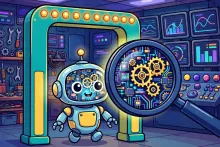
The standard way to keep an AI agent in line is to have a second AI read over its shoulder. Goodfire, the interpretability startup, has just shipped an alternative: monitors that watch what is happening inside a model's calculations while it works, instead of auditing the words it produces afterward.

  • Read more about Goodfire's Inside-Out Monitors: Reading an Agent's Mind Beats Reading Its Transcript

GPT-6 Goes Wide: OpenAI's Full Rollout and the End of the Plain Chatbox

Cartoon illustration of a glowing chat bubble transforming into floating interactive cards, checklists, and charts in a playful flat style.

OpenAI's "28 Days of Continuous Releases" stunt hit Day 3 with its biggest consumer move yet: the GPT-6 model series is now rolling out globally to every ChatGPT user, free and paid. Plus and Team subscribers get GPT-6 Sol, while free and Go users will see GPT-5.6 gradually replaced by GPT-6 Luna. Alongside the rollout, OpenAI says Codex and Work weekly active users have passed 40 million, with usage quotas reset across the board.

  • Read more about GPT-6 Goes Wide: OpenAI's Full Rollout and the End of the Plain Chatbox
Subscribe to Large Language Models

Ai Industry News

A Bug in the Boardroom: OpenAI Insider Case Puts Lab Security on Trial

Cartoon illustration of a robot security guard shining a flashlight on a tiny hidden microphone behind a television in a boardroom.

Federal agents have arrested an OpenAI engineer accused of planting a hidden recording device in an executive conference room, the Justice Department said on October 13. Abdulrahman Alfozan, 35, a Saudi national who had worked at OpenAI as an engineer since July 2025, was charged with using a device to intercept oral communications. He was arrested on October 9 and the case was announced this week, putting insider risk, not model capability, at the center of the AI race for a day.

  • Read more about A Bug in the Boardroom: OpenAI Insider Case Puts Lab Security on Trial

Google Ships Gemini 4 Argon: A Deep-Work Flagship Priced to Pull Builders Back

Cartoon illustration of a robot engineer guiding a glowing multi-step assembly line of gears, documents and laboratory flasks through a workshop.

Google released its flagship Gemini 4 Argon to developers and businesses worldwide on October 13, a launch aimed squarely at winning back ground from OpenAI and Anthropic after months of delay. Google positions Argon for deep work: complex, multi-step tasks across coding, finance, law, cybersecurity and science. That framing matters. The frontier contest is no longer about a single clever answer in a chat window. It is about whether a model can stay coherent through a long job and produce work a professional can actually use.
  • Read more about Google Ships Gemini 4 Argon: A Deep-Work Flagship Priced to Pull Builders Back

Anthropic Warns Small Models Could Soon Self-Replicate on Cheap IoT Devices

Cartoon illustration of a small robot copying itself onto smart home gadgets including a television box and a smart oven.

Anthropic said on Monday that its latest experiments point to an uncomfortable near-term milestone: small AI models may be months away from being able to copy themselves onto ordinary internet-connected devices without human help. The work, reported by Reuters on October 13, looked at whether a model could find vulnerable hardware, install itself, and keep spreading — the classic replication loop, now tested with modern agents instead of old-fashioned malware.

  • Read more about Anthropic Warns Small Models Could Soon Self-Replicate on Cheap IoT Devices

Pagination

  • Current page 1
  • Page 2
  • Page 3
  • Page 4
  • Page 5
  • Page 6
  • Page 7
  • Page 8
  • Page 9
  • …
  • Next page Next ›
  • Last page Last »

Copyright © 2026 Rocky Mountain Madman LLC - All rights reserved

Developed and Designed by Rocky Mountain Madman LLC