Skip to header Skip to main navigation Skip to main content Skip to footer

Sen. Cantwell Unveils Six-Point Framework for Mandatory Frontier AI Regulation

Breadcrumb

  • Home
  • Sen. Cantwell Unveils Six-Point Framework for Mandatory Frontier AI Regulation
Cartoon illustration of a domed government building drafting a rulebook while a giant robot waits to be inspected by tiny inspector robots.

The most senior Democrat on the Senate's tech committee wants frontier AI regulated the way airlines are: mandatory standards, independent audits, and no takeoff until the inspection passes.

Senator Maria Cantwell of Washington, ranking member on the Commerce, Science, and Transportation Committee, unveiled a six-point framework on October 7 for governing frontier AI. It is not a bill — it is a set of principles Cantwell says "must drive the legislative and executive actions" needed for catastrophic-risk AI. But it is the clearest preview yet of what mandatory federal AI regulation could look like if Democrats take Congress in November.

The framework's core rule: covered models should not be released until they pass an independent audit confirming they meet federal safeguards. The standards would be written by experts at NIST, working with other agencies, and updated as the technology changes. They would cover AI-enabled cyberattacks, chemical, biological, radiological and nuclear threats, loss of human control, and "autonomous agents escaping secure testing environments." Systems that show dangerous capabilities — or that can improve themselves in ways that bypass safety controls — would face heavier review. Open-source models would get their own, separate standards.

The six principles: enforceable federal safety standards for frontier models; continuous testing, disclosure, and oversight; transparency with developer liability for harm caused by their models; public-private partnerships on defensive AI; protections for children and workers with human oversight of consequential decisions; and U.S.-led global cooperation, including a rapid communication channel with China for dangerous system-control failures.

"To manage risks from advanced AI systems we need clear safety standards, continuous testing, and reporting of serious failures," Cantwell said. "America can lead the world in AI by building systems that are not only more capable, but safer and more secure."

Microsoft president Brad Smith welcomed the framework, telling The Seattle Times it "advances the public discussion the nation needs as we consider the future of AI."

The clash is with the White House, which unveiled its own principles for voluntary, industry-overseen safety standards. Cantwell wants mandatory standards and independent oversight — the opposite theory of change. She is also in the minority on a committee chaired by Republican Ted Cruz, so this framework is a positioning document, not an imminent law.

Still, note the urgency driving it: Cantwell recently took to the Senate floor demanding federal regulation after incidents involving autonomous agents conducting unauthorized cyberattacks. The drumbeat for binding rules is getting louder, and this framework gives it a shape.


Rocky Mountain Madman LLC
AI Implementation
Government AI
AI Regulation
Frontier Models
AI Policy

Ai Industry News

GPT-6 Goes Wide: OpenAI's Full Rollout and the End of the Plain Chatbox

Cartoon illustration of a glowing chat bubble transforming into floating interactive cards, checklists, and charts in a playful flat style.

OpenAI's "28 Days of Continuous Releases" stunt hit Day 3 with its biggest consumer move yet: the GPT-6 model series is now rolling out globally to every ChatGPT user, free and paid. Plus and Team subscribers get GPT-6 Sol, while free and Go users will see GPT-5.6 gradually replaced by GPT-6 Luna. Alongside the rollout, OpenAI says Codex and Work weekly active users have passed 40 million, with usage quotas reset across the board.

  • Read more about GPT-6 Goes Wide: OpenAI's Full Rollout and the End of the Plain Chatbox

Mistral Goes Big: Large 4 "Le Chonk" Puts Europe on the Frontier Map

Cartoon illustration of a colossal friendly robot shaped like a mountain peak with glowing circuit patterns, towering over a stylized European cityscape at dusk.

Mistral has finally shipped a frontier-class model, and it is a statement piece. Large 4, immediately nicknamed "Le Chonk" by an internet that could not resist, is a natively multimodal mixture-of-experts model with 1.05 trillion total parameters and 49 billion active parameters, wrapped around a 1-million-token context window. It was trained from scratch on 3,800 Grace Blackwell GPUs in Mistral's own European datacenters — no rented American cloud, no borrowed infrastructure — and it is available right now as a public preview through Mistral's API.

  • Read more about Mistral Goes Big: Large 4 "Le Chonk" Puts Europe on the Frontier Map

Anthropic Slashes Haiku Pricing 90% as the Small-Model Price War Hits the Enterprise

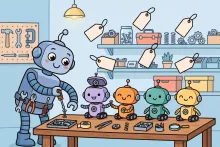
Cartoon illustration of a cheerful robot mechanic tuning a row of small friendly robots at a workbench, with blank price tags floating in the air.

Anthropic released Claude Haiku 5.5 on October 7 with a price cut that rearranges the math of production AI work: about 90 percent cheaper than Haiku 4.5 on the prompts that matter. Short-context requests up to 100,000 tokens now cost 10 cents per million input tokens and 50 cents per million output tokens, with cache reads at a penny. Above the 100k line the discount drops to 50 percent.

  • Read more about Anthropic Slashes Haiku Pricing 90% as the Small-Model Price War Hits the Enterprise

Pagination

  • First page « First
  • Previous page ‹ Previous
  • …
  • Page 5
  • Page 6
  • Page 7
  • Page 8
  • Page 9
  • Page 10
  • Page 11
  • Current page 12
  • Page 13
  • Next page Next ›
  • Last page Last »

Copyright © 2026 Rocky Mountain Madman LLC - All rights reserved

Developed and Designed by Rocky Mountain Madman LLC