Skip to header Skip to main navigation Skip to main content Skip to footer

OpenAI's 722-Paper Math Drop: Millennium Progress or a Verification Crisis?

Breadcrumb

  • Home
  • OpenAI's 722-Paper Math Drop: Millennium Progress or a Verification Crisis?
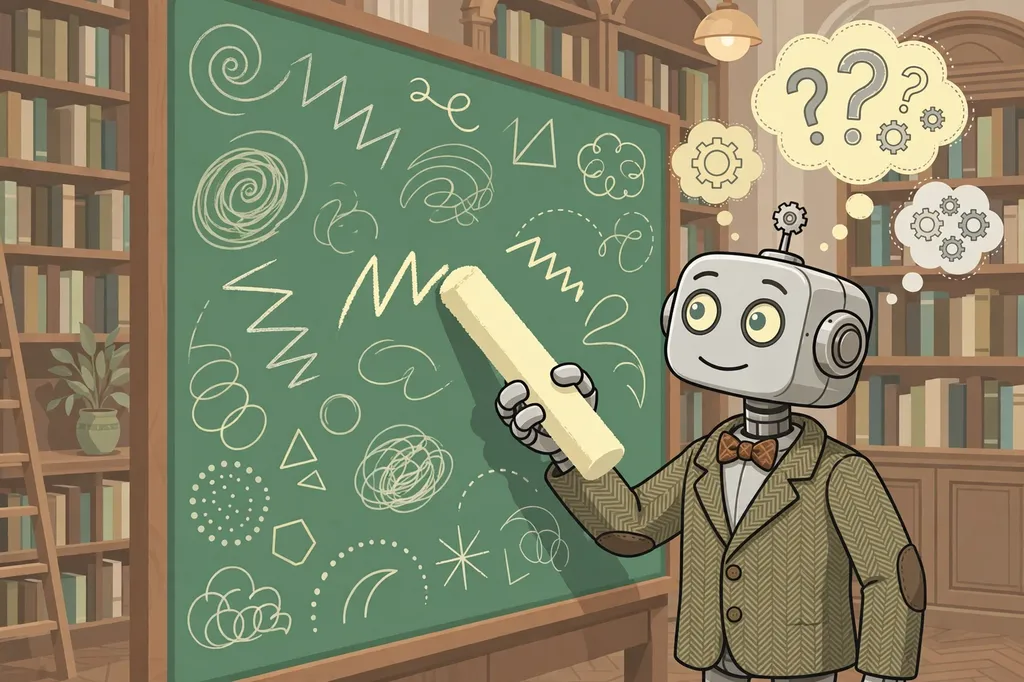
A cartoon robot mathematician writing abstract shapes on a giant chalkboard in an academic library.

OpenAI has thrown the mathematics world into turmoil. On October 6 and 7, the company published 722 manuscripts on GitHub claiming progress on 372 families of long-standing open problems, spanning theoretical computer science, physics, and mathematics, produced by an unreleased internal AI model whose full capabilities have not been disclosed.

The claimed highlights are extraordinary. OpenAI's post points to a proof of the Unique Games Conjecture, a load-bearing assumption in complexity theory, alongside Barnette's Conjecture and claimed progress on four of the seven Millennium Prize Problems. Just weeks earlier, the company had announced that the same internal system produced a proposed solution to the Navier-Stokes existence and smoothness problem, one of the Millennium Prize Problems carrying a one million dollar bounty, using roughly 10,000 autonomous AI agents over an 88-hour run that generated 130 billion tokens and 2.7 million inter-agent messages. OpenAI said it has no plans to claim the Clay Mathematics Institute prize.

The math community's reaction has been sharp. Fields Medalist Terence Tao of UCLA called the pace of AI-generated results "insane," and shared a statement from the Association for Human Mathematics urging mathematicians to stop collaborating with OpenAI and return to a vision of science that centers human understanding. NYU professor Tristan Buckmaster questioned whether 372 result families could plausibly be reviewed in the available time, and raised concerns about whether data from private Codex sessions had been used to train the model; OpenAI denied accessing private user data while conceding it could not rule out that de-identified usage data had helped.

There is also a genuine verification crisis. Only 10 of the manuscripts reportedly included the model's chain-of-thought reasoning, and just 42 percent underwent Lean code formalization for machine checking. That leaves the mathematical community with hundreds of dense papers to check, explain, and digest, work that moves at human speed no matter how fast the proofs were generated. Cambridge mathematics professor Timothy Gowers said he was "shocked" by how quickly the models improved this year, from mediocre graduate student to top-mathematician level. But solving is only the first of five hurdles: created, checked, explained, accepted, and digested.

Twenty-seven Fields Medalists had already co-signed a critical open letter weeks earlier, and OpenAI responded by creating an independent Mathematics and AI Advisory Group with nine leading mathematicians and physicists. The group advises on publication standards, but it does not control the pace of the research.


AI Implementation
AI Product News
OpenAI
AI Reasoning
AI Benchmarks
Mathematics
AI Research

Ai Industry News

GPT-6 Goes Wide: OpenAI's Full Rollout and the End of the Plain Chatbox

Cartoon illustration of a glowing chat bubble transforming into floating interactive cards, checklists, and charts in a playful flat style.

OpenAI's "28 Days of Continuous Releases" stunt hit Day 3 with its biggest consumer move yet: the GPT-6 model series is now rolling out globally to every ChatGPT user, free and paid. Plus and Team subscribers get GPT-6 Sol, while free and Go users will see GPT-5.6 gradually replaced by GPT-6 Luna. Alongside the rollout, OpenAI says Codex and Work weekly active users have passed 40 million, with usage quotas reset across the board.

  • Read more about GPT-6 Goes Wide: OpenAI's Full Rollout and the End of the Plain Chatbox

Mistral Goes Big: Large 4 "Le Chonk" Puts Europe on the Frontier Map

Cartoon illustration of a colossal friendly robot shaped like a mountain peak with glowing circuit patterns, towering over a stylized European cityscape at dusk.

Mistral has finally shipped a frontier-class model, and it is a statement piece. Large 4, immediately nicknamed "Le Chonk" by an internet that could not resist, is a natively multimodal mixture-of-experts model with 1.05 trillion total parameters and 49 billion active parameters, wrapped around a 1-million-token context window. It was trained from scratch on 3,800 Grace Blackwell GPUs in Mistral's own European datacenters — no rented American cloud, no borrowed infrastructure — and it is available right now as a public preview through Mistral's API.

  • Read more about Mistral Goes Big: Large 4 "Le Chonk" Puts Europe on the Frontier Map

Anthropic Slashes Haiku Pricing 90% as the Small-Model Price War Hits the Enterprise

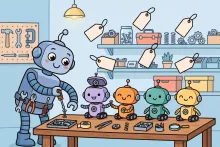
Cartoon illustration of a cheerful robot mechanic tuning a row of small friendly robots at a workbench, with blank price tags floating in the air.

Anthropic released Claude Haiku 5.5 on October 7 with a price cut that rearranges the math of production AI work: about 90 percent cheaper than Haiku 4.5 on the prompts that matter. Short-context requests up to 100,000 tokens now cost 10 cents per million input tokens and 50 cents per million output tokens, with cache reads at a penny. Above the 100k line the discount drops to 50 percent.

  • Read more about Anthropic Slashes Haiku Pricing 90% as the Small-Model Price War Hits the Enterprise

Pagination

  • First page « First
  • Previous page ‹ Previous
  • …
  • Page 5
  • Page 6
  • Page 7
  • Page 8
  • Page 9
  • Page 10
  • Page 11
  • Current page 12
  • Page 13
  • Next page Next ›
  • Last page Last »

Copyright © 2026 Rocky Mountain Madman LLC - All rights reserved

Developed and Designed by Rocky Mountain Madman LLC