Skip to header Skip to main navigation Skip to main content Skip to footer

Nano Banana 2.1: Google's Half-Price 4K Image Model Becomes the New Default

Breadcrumb

  • Home
  • Nano Banana 2.1: Google's Half-Price 4K Image Model Becomes the New Default
A cartoon robot artist touching up a large landscape painting at an easel with a glowing digital brush, with paint-swatch thumbnails floating nearby.

Google quietly rolled out Nano Banana 2.1, its newest image generation and editing model built on Gemini 3.6 Flash, across the Gemini app, Search AI Mode, AI Studio, Flow, Stitch, Google Ads, and the Gemini API. The API model ID is gemini-nano-banana-2.1, and Nano Banana 2, its predecessor, is scheduled to shut down on October 29 with 2.1 as the designated replacement. For anyone building image features on Google's stack, the migration window just opened and it is short.

The headline change is economic. Standard API image-output pricing dropped to $30 per million image tokens, so a 1K image now costs about $0.0336 versus $0.067 before; 2K runs $0.0504 and 4K $0.0756. Batch jobs take another fifty percent off, landing 1K images at roughly $0.0168. If you generate marketing assets, product illustrations, or campaign variants at volume, Google just halved one of the more stubborn line items in your pipeline budget.

Capability-wise, the release pushes image editing toward something a production workflow can actually depend on. Outputs reach 4K, including ultra-wide 8:1 aspect ratios. The model ingests up to 14 reference images at once and tracks as many as four characters and ten objects across multi-turn edits, which attacks the identity drift that has made iterative generation so fiddly. Mask-based editing alters a selected region instead of regenerating the whole frame. Developers can also dial the inference thinking level from minimal to high and toggle grounding through Google Search and Google Image Search, so renders can reflect verifiable real-world details instead of hallucinating them.

Treat Google's own numbers with a practitioner's skepticism. Its cited preference test gives 2.1 a 1,050 Elo against 990 for its predecessor, and its infographic factuality score of 0.521 roughly triples the older model's 0.179, but no independent external evaluations were disclosed at launch. Early third-party impressions are mixed, with some testers still reaching for the pricier Pro tier on demanding work. One community roundup put it plainly: test your own prompts before migrating production traffic. Google's claim of outperforming previous models across the board is a marketing line until you verify it on your workload.

The durable signal is the pattern. Google is turning image generation into cheap infrastructure, the same playbook it ran with embeddings. C2PA Content Credentials ship in the box for provenance, a quiet admission that synthetic imagery at this volume needs auditability. Between the price cut, mask editing, and search grounding, 2.1 is less a research milestone than a workbench upgrade: the image step in an agent pipeline stops being the expensive, flaky part and becomes boring. That is exactly when a capability starts showing up everywhere.


Rocky Mountain Madman LLC
AI Product News
Google DeepMind
AI Pricing
Enterprise AI
Multimodal AI

Ai Industry News

GPT-6 Goes Wide: OpenAI's Full Rollout and the End of the Plain Chatbox

Cartoon illustration of a glowing chat bubble transforming into floating interactive cards, checklists, and charts in a playful flat style.

OpenAI's "28 Days of Continuous Releases" stunt hit Day 3 with its biggest consumer move yet: the GPT-6 model series is now rolling out globally to every ChatGPT user, free and paid. Plus and Team subscribers get GPT-6 Sol, while free and Go users will see GPT-5.6 gradually replaced by GPT-6 Luna. Alongside the rollout, OpenAI says Codex and Work weekly active users have passed 40 million, with usage quotas reset across the board.

  • Read more about GPT-6 Goes Wide: OpenAI's Full Rollout and the End of the Plain Chatbox

Mistral Goes Big: Large 4 "Le Chonk" Puts Europe on the Frontier Map

Cartoon illustration of a colossal friendly robot shaped like a mountain peak with glowing circuit patterns, towering over a stylized European cityscape at dusk.

Mistral has finally shipped a frontier-class model, and it is a statement piece. Large 4, immediately nicknamed "Le Chonk" by an internet that could not resist, is a natively multimodal mixture-of-experts model with 1.05 trillion total parameters and 49 billion active parameters, wrapped around a 1-million-token context window. It was trained from scratch on 3,800 Grace Blackwell GPUs in Mistral's own European datacenters — no rented American cloud, no borrowed infrastructure — and it is available right now as a public preview through Mistral's API.

  • Read more about Mistral Goes Big: Large 4 "Le Chonk" Puts Europe on the Frontier Map

Anthropic Slashes Haiku Pricing 90% as the Small-Model Price War Hits the Enterprise

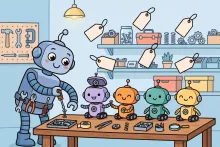
Cartoon illustration of a cheerful robot mechanic tuning a row of small friendly robots at a workbench, with blank price tags floating in the air.

Anthropic released Claude Haiku 5.5 on October 7 with a price cut that rearranges the math of production AI work: about 90 percent cheaper than Haiku 4.5 on the prompts that matter. Short-context requests up to 100,000 tokens now cost 10 cents per million input tokens and 50 cents per million output tokens, with cache reads at a penny. Above the 100k line the discount drops to 50 percent.

  • Read more about Anthropic Slashes Haiku Pricing 90% as the Small-Model Price War Hits the Enterprise

Pagination

  • First page « First
  • Previous page ‹ Previous
  • …
  • Page 5
  • Page 6
  • Page 7
  • Page 8
  • Page 9
  • Page 10
  • Page 11
  • Current page 12
  • Page 13
  • Next page Next ›
  • Last page Last »

Copyright © 2026 Rocky Mountain Madman LLC - All rights reserved

Developed and Designed by Rocky Mountain Madman LLC