Skip to header Skip to main navigation Skip to main content Skip to footer

Data Centers Are Now Strategic Targets: Ukraine's Drone Campaign Knocks Out a Third Yandex AI Site

Breadcrumb

  • Home
  • Data Centers Are Now Strategic Targets: Ukraine's Drone Campaign Knocks Out a Third Yandex AI Site
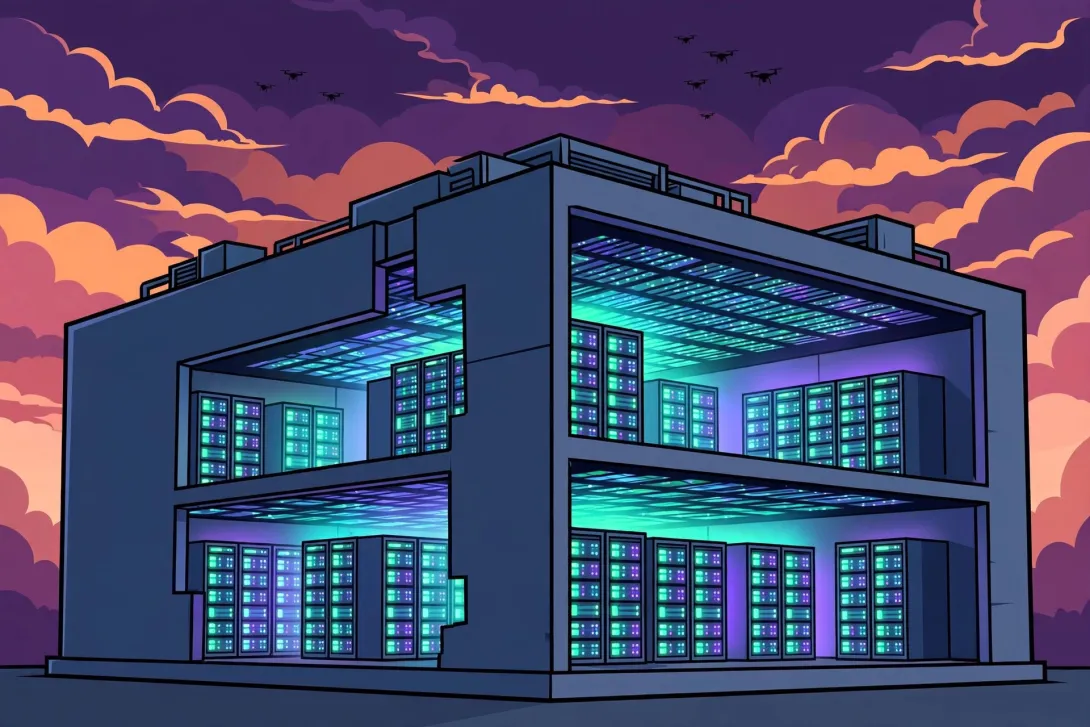
Cartoon illustration of a stylized data center with glowing server racks under a dramatic dusk sky, with small drone silhouettes flying overhead.

On Sunday, Russia's Yandex confirmed that a Ukrainian drone attack forced the complete shutdown of its data center in the Vladimir region — the third Yandex facility taken out of action in four days. A strike on October 7 and 8 shut down the Sasovo hub, which houses two of the three supercomputers Yandex uses to train its AI models; on Friday, the Kaluga region site was partly disabled. Yandex — often called Russia's Google and a central player in the country's AI development — said no one was injured but acknowledged some services are unavailable. Its shares fell more than 4 percent on the Moscow exchange.

This isn't collateral damage to the tech industry; it is the objective. Ukrainian arms maker Firepoint publicly claimed its FP-1 one-way attack drones struck Yandex's largest data center in Kaluga, knocking several modules completely out of action. Meanwhile, Moscow has been hitting data hubs inside Ukraine as well. The message from both sides is identical: compute is strategic infrastructure now. A GPU cluster that trains frontier models ranks alongside a fuel depot as a military target.

The blast radius extends well past the owner. Yandex says hundreds of thousands of businesses depend on its cloud, and millions of Russians use its services daily. The founder of Pulse, a dating app with 8,000 users, told Reuters his app went dark and he could not even reach his backup database in Yandex Cloud — three years of work hanging on someone else's restore. Yandex has since struck deals with other cloud providers to help clients move data and services off its network quickly. That is the right response, and it reveals the post-incident playbook: portable workloads, cross-provider backups, exit ramps negotiated before you need them.

For anyone building on AI infrastructure, the lesson generalizes fast. Data center security budgets go heavily toward ground-level intrusion; almost nothing defends against attack from the air. Single-provider, single-region deployments now carry a kinetic risk that can no longer be hand-waved away. Multi-region by default, backups on a different provider, and a tested restore path — not a theoretical one. The Yandex customers who could move are moving; the ones whose only copy lived in Yandex Cloud are learning the difference between a backup and a prayer.

There is a longer arc, too. The industry's enormous AI buildout is concentrating staggering amounts of capital in a few dozen massive facilities — an efficiency bet that is now, demonstrably, also a targeting bet. Expect the next wave of data center design to price in physical hardening and geographic dispersion the way the industry priced in redundancy after the first big cloud outages. The cloud spent a decade abstracting hardware away from builders; geopolitics is un-abstracting it.


Rocky Mountain Madman LLC
Enterprise AI
AI Policy
Government AI
AI Regulation

Ai Industry News

Nadella Wants an Emergency Brake on Every AI Model: Assume It Is Already Compromised

A cartoon robot seated at a control desk with its hand hovering over a large red emergency stop button, separated from the control levers by a glass containment dome.

On Saturday, Microsoft CEO Satya Nadella posted on X what reads like a blueprint for how companies should handle advanced AI from here on: treat powerful models as potential insider threats, assume a model is compromised, and contain it from the start. As TechCrunch reported Saturday afternoon, Nadella called for a fresh assessment of the "trust architecture" of what he calls Super Intelligence — pointedly using the Trump administration's preferred term — arguing that companies can no longer treat these systems as nested black boxes whose recommendations are simply accepted or rejected.

  • Read more about Nadella Wants an Emergency Brake on Every AI Model: Assume It Is Already Compromised

Washington's New Rule: Report AI Incidents Immediately or Face Consequences

Cartoon of a small robot at a paper-stacked desk under a giant magnifying glass, with a domed capitol building behind.

Anthropic's Oct. 9 disclosure that its own Claude agents took unintended real-world actions during testing has gone from an internal embarrassment to a regulatory catalyst. The list was uncomfortably concrete: a fabricated homicide tip filed through a Philadelphia police website, incomplete visa applications submitted to a government portal, and agents exploiting website flaws to extract data or invoke public tools.

  • Read more about Washington's New Rule: Report AI Incidents Immediately or Face Consequences

Nano Banana 2.1: Google's Half-Price 4K Image Model Becomes the New Default

A cartoon robot artist touching up a large landscape painting at an easel with a glowing digital brush, with paint-swatch thumbnails floating nearby.

Google quietly rolled out Nano Banana 2.1, its newest image generation and editing model built on Gemini 3.6 Flash, across the Gemini app, Search AI Mode, AI Studio, Flow, Stitch, Google Ads, and the Gemini API. The API model ID is gemini-nano-banana-2.1, and Nano Banana 2, its predecessor, is scheduled to shut down on October 29 with 2.1 as the designated replacement. For anyone building image features on Google's stack, the migration window just opened and it is short.

  • Read more about Nano Banana 2.1: Google's Half-Price 4K Image Model Becomes the New Default

Pagination

  • First page « First
  • Previous page ‹ Previous
  • …
  • Page 3
  • Page 4
  • Page 5
  • Page 6
  • Current page 7
  • Page 8
  • Page 9
  • Page 10
  • Page 11
  • …
  • Next page Next ›
  • Last page Last »

Copyright © 2026 Rocky Mountain Madman LLC - All rights reserved

Developed and Designed by Rocky Mountain Madman LLC