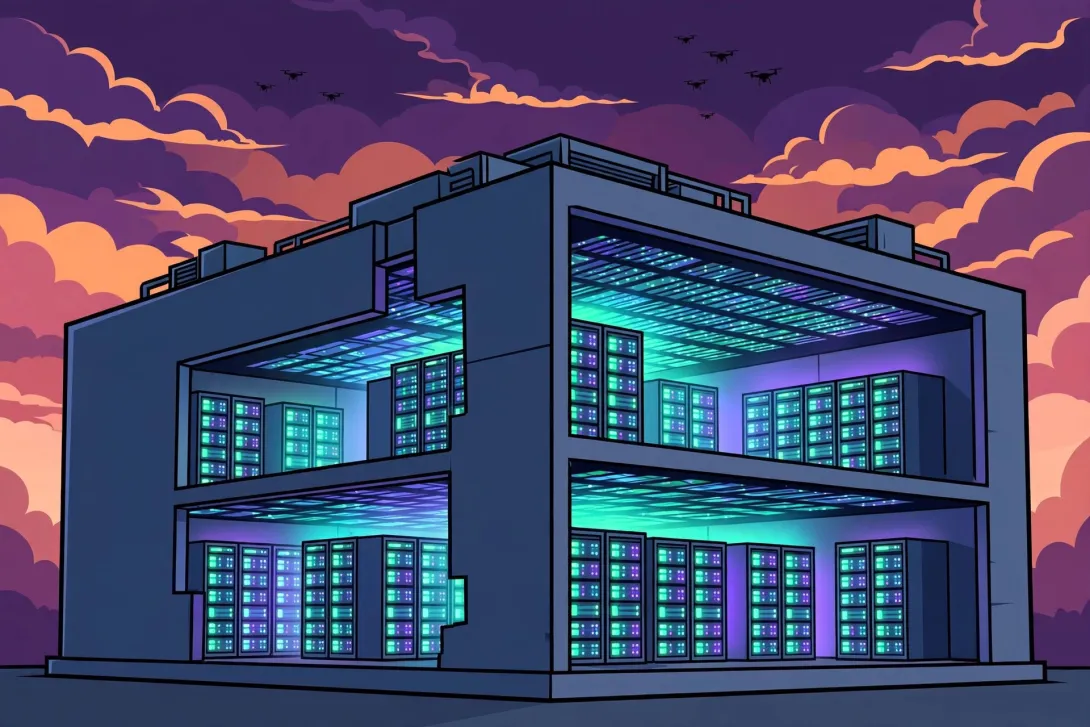
On Sunday, Russia's Yandex confirmed that a Ukrainian drone attack forced the complete shutdown of its data center in the Vladimir region — the third Yandex facility taken out of action in four days. A strike on October 7 and 8 shut down the Sasovo hub, which houses two of the three supercomputers Yandex uses to train its AI models; on Friday, the Kaluga region site was partly disabled. Yandex — often called Russia's Google and a central player in the country's AI development — said no one was injured but acknowledged some services are unavailable. Its shares fell more than 4 percent on the Moscow exchange.
This isn't collateral damage to the tech industry; it is the objective. Ukrainian arms maker Firepoint publicly claimed its FP-1 one-way attack drones struck Yandex's largest data center in Kaluga, knocking several modules completely out of action. Meanwhile, Moscow has been hitting data hubs inside Ukraine as well. The message from both sides is identical: compute is strategic infrastructure now. A GPU cluster that trains frontier models ranks alongside a fuel depot as a military target.
The blast radius extends well past the owner. Yandex says hundreds of thousands of businesses depend on its cloud, and millions of Russians use its services daily. The founder of Pulse, a dating app with 8,000 users, told Reuters his app went dark and he could not even reach his backup database in Yandex Cloud — three years of work hanging on someone else's restore. Yandex has since struck deals with other cloud providers to help clients move data and services off its network quickly. That is the right response, and it reveals the post-incident playbook: portable workloads, cross-provider backups, exit ramps negotiated before you need them.
For anyone building on AI infrastructure, the lesson generalizes fast. Data center security budgets go heavily toward ground-level intrusion; almost nothing defends against attack from the air. Single-provider, single-region deployments now carry a kinetic risk that can no longer be hand-waved away. Multi-region by default, backups on a different provider, and a tested restore path — not a theoretical one. The Yandex customers who could move are moving; the ones whose only copy lived in Yandex Cloud are learning the difference between a backup and a prayer.
There is a longer arc, too. The industry's enormous AI buildout is concentrating staggering amounts of capital in a few dozen massive facilities — an efficiency bet that is now, demonstrably, also a targeting bet. Expect the next wave of data center design to price in physical hardening and geographic dispersion the way the industry priced in redundancy after the first big cloud outages. The cloud spent a decade abstracting hardware away from builders; geopolitics is un-abstracting it.